

A successful soft-landing Germany strategy gives international companies a structured, lower-risk way to enter the German market, test demand, build a European presence, and expand business activities across the European Union through market entry support, legal orientation, company establishment guidance, and partner and sales development. For companies from Asia, North America, the Middle East, Africa or other parts of the world at an early stage of expansion, Germany is often more than just one country in Europe. It is a practical entry point into the single market, a legally stable business environment, and a central location for sales, services, investment, logistics, technology, and long-term company development.
A soft-landing Germany approach is especially relevant for international companies at an early stage of European expansion. Instead of immediately building a large office, hiring a full team and committing to major investment, a company can test the market, validate demand, build partners, understand German law, evaluate EU law, plan human resources, assess office or site options, and develop a scalable market strategy before making larger decisions.
Germany favors freedom of foreign trade and payment transactions in principle. Under Germany’s Foreign Trade and Payments Act, trade in goods, services, capital, payment transactions and other foreign trade activities are generally not restricted unless specific legal restrictions apply. At the same time, acquisitions of German companies by foreign buyers can be reviewed under investment screening rules, especially when voting rights thresholds or sensitive sectors are involved. Germany’s Federal Ministry for Economic Affairs states that acquisitions of at least 10% voting rights in specifically defined critical infrastructure or certain security-relevant services must be reported.
For any international enterprise, the main aim of a soft-landing is simple: enter Germany with clarity, avoid unnecessary restrictions, reduce legal and operational risk, and build a sustainable European business step by step. This article explains the key decisions involved, from market entry and regulatory orientation to company setup, hiring, location selection, partner and sales development, and broader European expansion opportunities.
What does soft-landing Germany mean?
soft-landing Germany describes a structured support process for foreign companies that want to establish, test or expand business in Germany and Europe. It usually includes market entry support, legal orientation, company establishment guidance, office or site selection, partner search, sales development, human resources planning, language support, and further information on national laws and EU rules.
The process can be useful for a company that wants to:
- Enter the German market for the first time
- Build a representative office, sales office or subsidiary
- Test products, services or information technology solutions
- Develop partnerships with German and European companies
- Understand legal, tax, HR and compliance requirements
- Prepare investment, hiring, sales and marketing activities
- Use Germany as a base for the rest of Europe and the European Union
A strong soft-landing Germany program is not only about administration. It is an integral part of a broader market strategy. The company needs to know where demand exists, which partners are involved, which transactions are legally possible, which restrictions may apply, and how German customers evaluate trust, quality, documentation, service and long-term reliability.

Why Germany is a strategic entry point into Europe
Germany remains one of the most important business locations in Europe. It is part of the European Union, the single market, the euro area, and one of the most developed industrial and services economies in the world. For international companies, this combination creates a strong platform for business activities, sales development, information technology services, manufacturing cooperation, logistics, research, investment, and European expansion.
The German market is attractive because it combines economic scale, central location, strong infrastructure, legal predictability, high purchasing power, and access to other EU member states. From Germany, companies can serve customers in France, the Netherlands, Austria, Poland, Italy, Belgium, the Nordics and the rest of Europe.
However, Germany is also a demanding country for market entry. Competitive pressure is high. Customers often expect strong technical documentation, reliable service, data protection compliance, transparent pricing, local language skills, and a clear legal structure. This is why a soft-landing Germany is so valuable: it helps companies understand the German market before they overinvest.
Germany’s current economic soft-landing: what companies should know
The phrase “soft-landing” also has an economic meaning. A soft-landing describes a situation in which inflation slows and growth stabilizes without a significant recession. For Germany, this matters because international companies need to understand the current economic environment before planning establishment, hiring and investment.
According to the European Commission’s May 2026 forecast, Germany’s GDP growth is projected at around 0.6% in 2026 and 0.9% in 2027 after weak growth in 2025. The recovery is expected to be supported mainly by public spending, while private investment is recovering gradually. The same forecast expects German unemployment to rise to approximately 4.0% in 2026 before slightly easing to 3.9% in 2027, while inflation is projected at 2.9% in 2026 and 2.7% in 2027.
For international companies, this creates both caution and opportunity. Modest growth, higher energy costs, geopolitical risks, and weak private investment may cause economic volatility. At the same time, public investment, infrastructure spending, job security, and a stabilizing inflation environment can support consumer confidence and business demand in selected sectors.
Long-term structural challenges may keep overall growth modest in Germany. The Bundesbank has warned that demographic change is reducing labor supply and weighing on economic growth, especially as many baby boomers enter retirement. This means companies should take human resources planning seriously from the beginning. Skills shortages, language skills, talent retention and immigration processes for foreign nationals are not side topics. They are central to any realistic soft-landing Germany plan.
Soft-landing Germany and the European Union
A German market entry is also a European market entry. Germany is an EU member state, and many business activities are shaped by EU law, EU legislation, single market rules, product standards, customs rules, data protection, competition law, consumer protection, labour mobility and freedom to provide services.
The European Union is built on cooperation between member states, the European Commission, the European Parliament, the European Council and the Council of the EU. For companies, this institutional system matters because EU law often sets the framework for business operations, while national laws such as German law define specific implementation, procedures, authorities and legal obligations.
A company planning soft-landing Germany should therefore distinguish between:
- EU law and EU legislation
- German law and German national laws
- Local rules at city, state or regional level
- Industry-specific regulations
- Tax, employment, immigration and data protection obligations
- Sector-specific restrictions for sensitive activities
This is especially important for companies in information technology, artificial intelligence, cybersecurity, medical technology, fintech, energy, defence-related services, infrastructure, logistics, manufacturing, data services and regulated professional services.
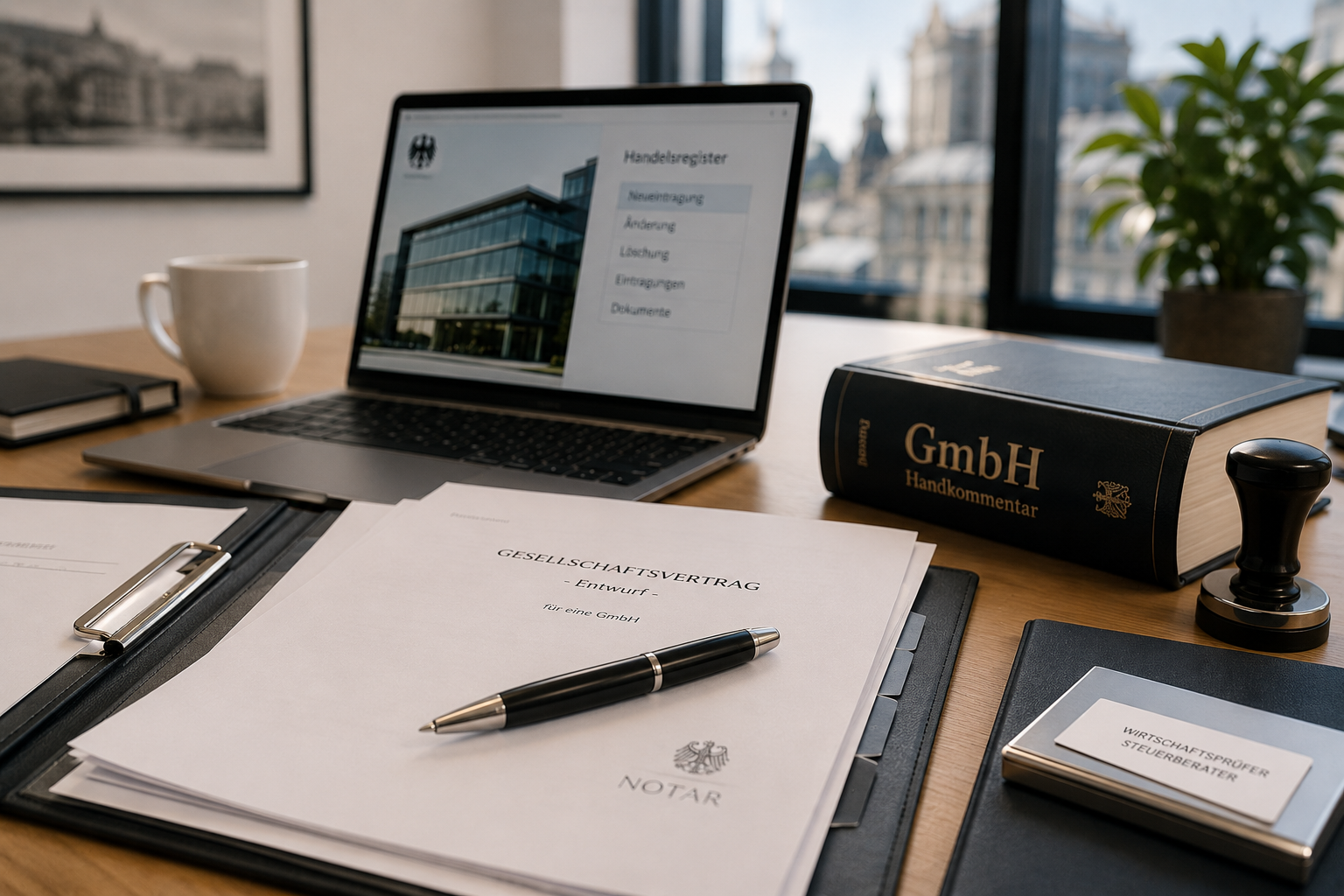
Company establishment in Germany: from plan to office
The establishment process in Germany usually starts with a clear business plan and market strategy. A foreign company should define whether it wants to open a sales office, a branch, a subsidiary, a representative office or another legal structure. The right choice depends on business activities, liability, taxation, hiring plans, investment, expected transactions, and the level of independence from the parent company.
Typical steps include:
- Choosing the right legal form
- Checking company name availability
- Preparing articles of association
- Notarial registration
- Commercial register entry
- Tax registration
- Opening a bank account
- Setting up accounting and payroll
- Finding an office or site
- Hiring staff or local partners
- Preparing contracts, legal documents and sales materials
For many foreign nationals and non-German founders, the process can feel complex at first. The challenge is not only legal. It includes language skills, administrative timing, German documentation standards, local expectations, and communication with banks, authorities, landlords, partners and service providers.
A soft-landing Germany service can support this process by helping the company coordinate legal, tax, HR, office, sales and market development steps in one managed process.
Investment screening and legal restrictions in Germany
Germany is open to foreign investment, but certain transactions can be reviewed when public order, security, critical infrastructure or sensitive technologies are involved. This is particularly important for non-EU buyers.
In general, foreign trade and payment transactions are free in Germany, but the Foreign Trade and Payments Act allows restrictions where legally required. For investment screening, the German authorities may review acquisitions of German companies by foreign buyers. Mandatory reporting can apply at lower thresholds in critical infrastructure and security-relevant sectors, including acquisitions of at least 10% voting rights in defined critical infrastructure or certain security-relevant services. Sector-specific reviews also apply in sensitive security areas such as defence-related or cryptography-related activities.
For international companies, the practical point is clear: greenfield investments, such as the founding of a new company or opening a new site without acquiring an existing German company, are typically different from acquisitions. However, if a company plans to buy shares, acquire voting rights, take over a German enterprise or invest in sensitive infrastructure, legal review must be part of the market strategy from the beginning.
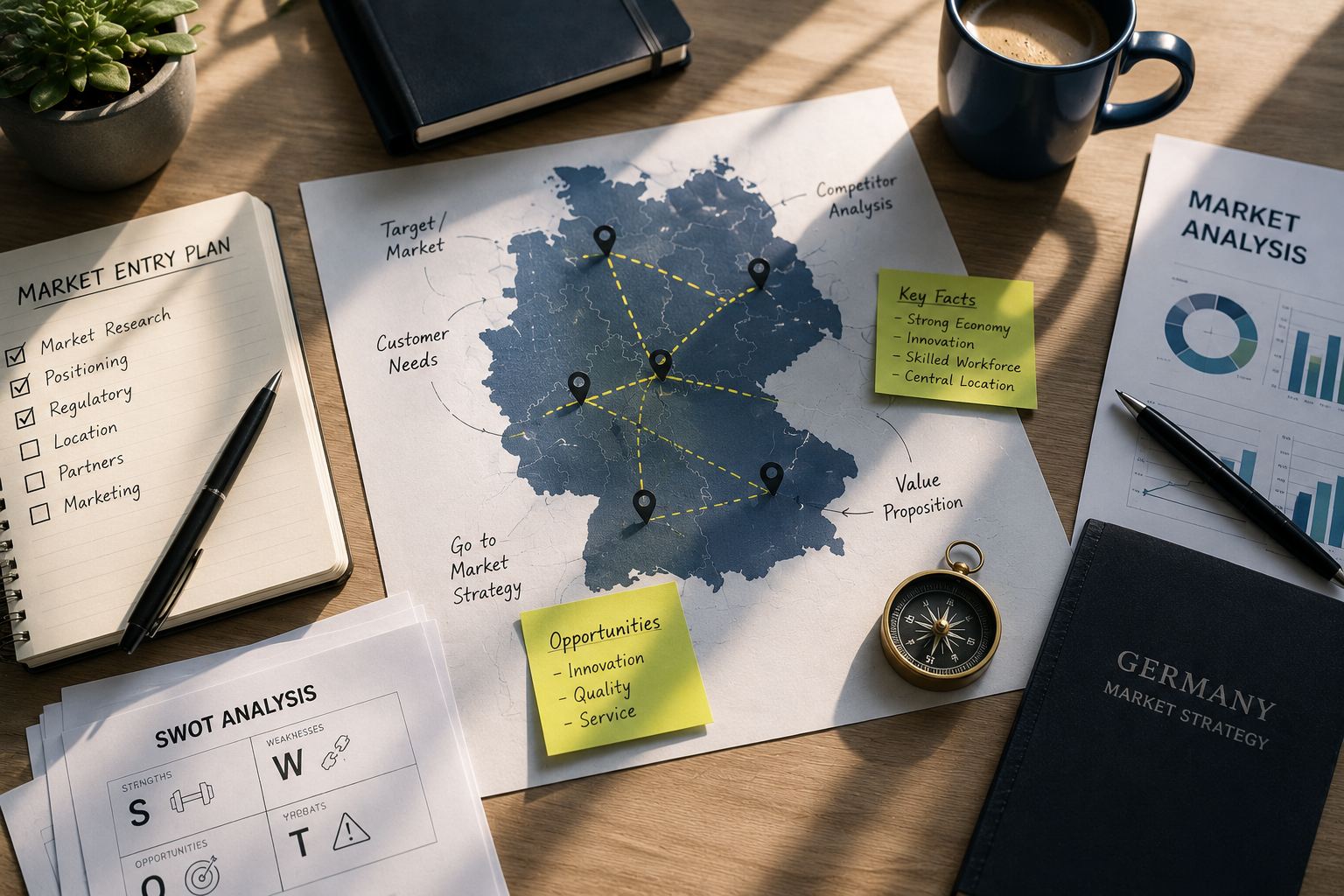
Market strategy for the German market
A successful market strategy for the German market should not simply copy the strategy used in the home country. Germany has its own customer expectations, buying processes, legal framework, sales cycles and competitive pressure.
A strong German market strategy should answer these questions:
- Which customer segment has the highest demand?
- Which region offers the best first entry point?
- Which partners can accelerate trust and sales?
- Which legal and technical standards are required?
- Which language skills are needed for sales, support, and documentation?
- Which competitors are already established?
- Which services should be localized?
- Which pricing model works in Germany and the rest of Europe?
- Which office or site supports credibility and access?
For example, a French company entering Germany may already understand parts of EU law and single market rules, but it still needs to adapt to German law, German customer behavior and German-language sales communication. A company from a non-EU country may need more support with visa rules for foreign nationals, company establishment, tax registration, and compliance with both EU law and national laws.
The same applies in reverse: a company using Germany as its European base may later develop sales in France, the Netherlands, Austria or other EU member states. A good soft-landing Germany approach therefore prepares not only the first German transaction, but also the next European growth stage.
Human resources, language skills and foreign nationals
Human resources are often underestimated in early stage expansion. International companies may assume that hiring in Germany is easy because the country has a large labour market. In reality, demographic change, skills shortages and competitive pressure for qualified employees can make hiring challenging.
The Bundesbank has highlighted that demographic ageing is reducing Germany’s labour supply and will remain a long-term challenge. This is particularly relevant for companies in information technology, engineering, healthcare, sales, skilled trades, logistics, consulting, research and technical services.
A company should plan HR early. This includes employment contracts under German law, payroll, social security, working time rules, vacation, termination protection, remote work policies, and onboarding. Foreign nationals may also need visa or residence processes, depending on nationality, role and employment structure.
Language skills are another key issue. English may be enough for some international B2B settings, especially in information technology, finance or research but for sales, public administration, human resources, legal documents and customer service, German language skills often create a major advantage.
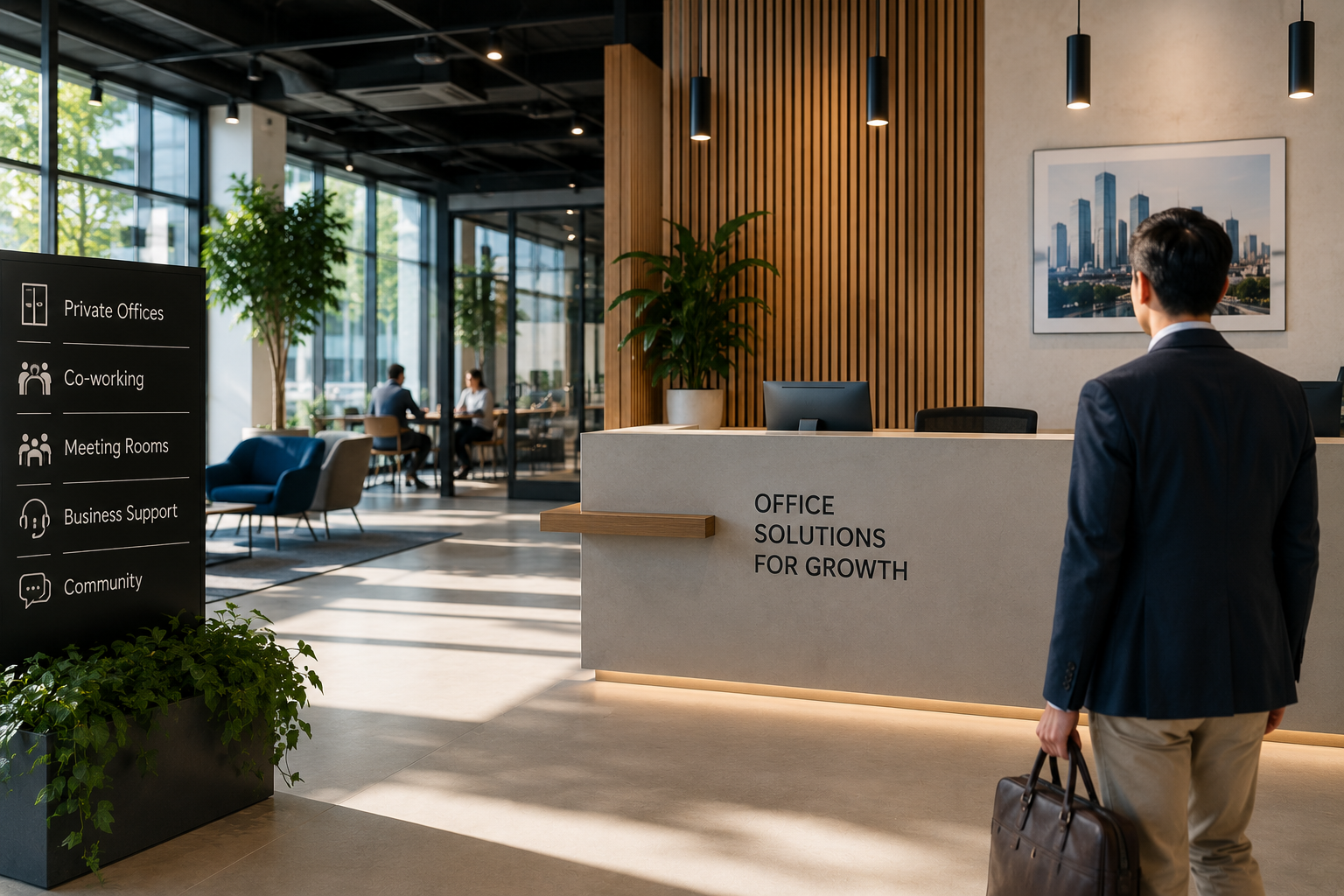
Office, site and regional development
Choosing the right office or site is part of the soft-landing process. Germany is not one single business environment. Each region has different strengths, costs, talent pools, industry clusters and partner networks.
Frankfurt and the Rhein-Main region, for example, are attractive for international companies because of the airport, logistics access, financial services, international communities, trade fair connections, universities, consulting networks and proximity to many established companies. In German search behavior, users may even look for support “in der Region,” (in the metro area) which makes regional visibility relevant for SEO, AI Search and local business development.
Other regions may be better for manufacturing, automotive, information technology, life sciences, renewable energy, logistics or research. The right location depends on the company’s business activities, customers, supply chain, hiring needs and investment plan.
Germany as a base for EU member states and new markets
Germany gives companies access to the single market, but market entry does not end at the German border. The European Union currently consists of multiple member states, each with national laws, language differences, tax details and local business cultures. EU membership creates a shared legal and economic framework, but companies still need local adaptation.
The single market supports the freedom of goods, services, capital and people. For companies, this can make cross-border sales and service delivery easier. However, national laws still matter in areas such as tax, employment, consumer protection enforcement, business registration, professional licensing and public procurement.
A company should therefore treat Germany as a strong European base, not as a substitute for understanding each country. Expansion into France, the Netherlands, Austria, Poland or the rest of Europe should follow a structured plan.
EU enlargement, candidate countries and future opportunities
Companies expanding into Europe should also understand EU enlargement. New countries joining the European Union can create future market opportunities, new regulatory alignment, new supply chain options and new investment conditions.
A country must submit a membership application to the EU. The accession process can begin after all EU member states agree to the request, and formal accession negotiations, as part of broader membership negotiations, require agreement by all EU member states. These negotiations focus on adoption of EU law and the required judicial, administrative and economic reforms. At the end of the process, the accession treaty requires consent from the European Parliament and unanimous approval by the Council before ratification by all parties.
The Copenhagen criteria are the key membership criteria. They require stable institutions guaranteeing democracy, the rule of law, human rights and respect for minorities, as well as a functioning market economy and the ability to take on the obligations of EU membership.
This is relevant for international companies because candidate countries, potential candidate countries and new member states may become important locations for production, sales, services and investment. The Western Balkans are an important example. North Macedonia was identified as a potential candidate together with other Western Balkans partners, applied for EU membership in March 2004, was granted candidate status in December 2005, and opened membership negotiations in October 2022. Montenegro applied for EU membership in 2008, was granted candidate status in 2010, began accession negotiations in 2012, aims for EU membership by 2028, and has provisionally closed multiple negotiation chapters, including chapters on freedom of movement for workers and consumer and health protection in June 2026. Romania and Bulgaria joined the EU on 1 January 2007, marking a key enlargement step for the integration of their citizens into the wider EU framework.
For companies, this means that a European market strategy should not only consider current EU member states. It should also monitor candidate countries, countries joining in the future, granted candidate status decisions, regular reports by the European Commission, and the broader accession process.
The role of EU institutions in business expansion
The European Commission proposes and monitors legislation, issues regular reports on enlargement and candidate progress, and plays an important role in enforcing EU law. The European Parliament is involved in legislation and must consent to accession treaties. The European Council sets broad political priorities, while the Council of the EU represents member states and supervises enlargement and accession negotiations.
For a company, these institutions may seem distant at first. But they influence practical business realities, including product rules, digital regulation, environmental standards, sustainability reporting, competition law, data protection, market access, consumer rights, customs, sanctions and investment screening.
A strong soft-landing Germany process therefore includes not only local establishment support, but also a basic understanding of how EU law, German law and national laws interact.

Practical soft-landing Germany roadmap
A practical soft-landing Germany roadmap should be developed in stages.
Stage 1: Market validation
At the early stage, the company should test demand, identify customer groups, analyze competitors, review pricing, and understand whether the German market offers real potential. This stage should include sales interviews, partner mapping, trade fair analysis, digital visibility checks and further information on legal or technical barriers.
Stage 2: Legal and regulatory orientation
Before signing contracts or starting transactions, the company should clarify legal structure, tax obligations, employment rules, data protection, sector-specific restrictions, investment screening risks and relevant EU law. This is especially important for regulated services, information technology, infrastructure, finance, healthcare and security-sensitive sectors.
Stage 3: Establishment and office setup
The company can then establish a German legal entity, branch or representative structure. It may also choose a coworking office, serviced office, innovation hub, regional site or permanent office. The site decision should support credibility, access to partners, hiring and customer development.
Stage 4: Sales and partner development
German sales often depend on trust, references, technical quality and local support. International companies should develop German-language materials, define lead generation channels, identify associations, chambers, industry networks and local partners, and build a realistic sales pipeline.
Stage 5: Human resources and operational scaling
Once the first customers or partners are established, the company can build a local team. Human resources planning should include recruitment, payroll, employment contracts, onboarding, management structure, language skills and long-term retention.
Stage 6: Expansion into the rest of Europe
After the German base is working, the company can expand into other EU member states. France is often a relevant next market, especially for B2B services, industrial products, information technology and cross-border partnerships. A French expansion strategy should consider language, national laws, sales culture and local compliance, even though both Germany and France are part of the European Union.
Soft-landing Germany for information technology companies
Information technology companies often choose Germany because of its industrial customer base, cybersecurity needs, cloud transformation, AI development, enterprise software demand and strong B2B sectors. However, they must take compliance seriously.
Relevant issues may include GDPR, cybersecurity requirements, data hosting, AI legislation, contractual liability, service-level agreements, intellectual property, employment rules and customer procurement processes. German customers often expect detailed documentation, technical support, references and clear legal accountability.
For an information technology company, soft-landing Germany should combine market strategy, legal review, sales enablement, partner development and local trust-building. The company should also evaluate whether public-sector customers, critical infrastructure customers or regulated industries create additional restrictions.
Soft-landing Germany for industrial and manufacturing companies
Manufacturing and industrial companies may use Germany as a sales market, production site, R&D location or European headquarters. Germany’s industrial base can create strong opportunities, but also high expectations regarding certification, quality, delivery reliability, documentation, warranty, technical service and sustainability.
Before establishment, companies should analyze supply chains, logistics, customer requirements, product compliance, EU legislation, German law, industry standards and potential partners. If acquisitions are involved, investment screening must be checked early. If a greenfield investment is planned, the process may focus more on site selection, permits, staffing, incentives, utilities, logistics and supplier networks.
Common mistakes international companies make in Germany
Many companies fail not because the German market has no potential, but because the entry process is poorly managed.
Common mistakes include:
- Entering Germany without a clear market strategy
- Underestimating German law and national laws
- Ignoring EU law and sector-specific legislation
- Using English-only sales materials in traditional industries
- Hiring too late or without understanding employment law
- Choosing an office or site only based on cost
- Relying on one partner without building a broader network
- Assuming that EU membership makes all countries identical
- Ignoring competitive pressure from established German and European companies
- Starting transactions before legal and tax questions are clarified
A soft-landing approach reduces these risks by giving the company a structured process, local support and a realistic plan.

FAQ: Soft-landing Germany
What is the main purpose of soft-landing Germany?
The main purpose of soft-landing Germany is to help an international company enter the German market with lower risk. It supports market strategy, company establishment, legal orientation, office setup, sales development, human resources and partner building.
Why is Germany a good entry point into Europe?
Germany is a central European country, an EU member state and part of the single market. It offers access to customers, partners, infrastructure, services, investment opportunities and other EU member states. For many companies, Germany is the first step toward broader expansion in Europe.
Do foreign companies need to understand both German law and EU law?
Yes. EU law creates the broader framework for many business activities, but German law and national laws define many practical obligations. A company must understand both levels before starting transactions, hiring staff or providing regulated services.
Are foreign investments restricted in Germany?
Germany generally supports freedom of foreign trade and payment transactions, but certain acquisitions can be reviewed. This is especially relevant for non-EU buyers, critical infrastructure, sensitive security areas and acquisitions involving specific voting rights thresholds.
Is a greenfield investment reviewed like an acquisition?
A greenfield investment, such as founding a new company or opening a new office or site, is usually different from acquiring voting rights in an existing German company. However, companies should still review permits, sector rules, sanctions, export control, tax, employment law and other legal obligations.
What role does human resources play in soft-landing Germany?
Human resources are an integral part of soft-landing Germany. Companies must understand German employment law, payroll, social security, recruitment, language skills, onboarding and retention. Skills shortages and demographic change make early HR planning especially important.
Can Germany be used as a base for the rest of Europe?
Yes. Many companies use Germany as a base for the European Union and the rest of Europe. However, each country has its own national laws, language, business culture and local market conditions. Expansion into France, the Netherlands, Austria or other EU member states should be planned separately.
Why are EU candidate countries relevant for European expansion?
Candidate countries and potential candidate countries can become future markets, production locations or service hubs. The accession process, Copenhagen criteria, European Commission regular reports, European Council decisions and European Parliament consent all shape when new countries may join the European Union.
What are the Copenhagen criteria?
The Copenhagen criteria are the key membership criteria for EU accession. They require democracy, rule of law, human rights, protection of minorities, a functioning market economy and the ability to adopt the obligations of EU membership.
How long does soft-landing Germany take?
The timeline depends on the company, sector, legal structure, investment plan, hiring needs and market readiness. Some companies begin with a short market validation phase, while others need a longer process involving legal setup, office selection, HR planning, partner development and sales execution.
Conclusion: soft-landing Germany as a strategic European growth process
A successful soft-landing Germany strategy is not just about entering one country. It is about building a structured bridge into Germany, the European Union and the wider European market. International companies that take the process seriously can reduce risk, avoid costly mistakes, understand restrictions, build partners, hire better, localize sales, and develop long-term business activities.
Germany offers access to one of the most important markets in Europe, but it rewards preparation. Companies need a clear market strategy, a realistic investment plan, legal guidance, human resources planning, language skills, regional understanding and knowledge of EU law, German law and national laws.
For international companies expanding into Europe, soft-landing Germany is therefore not a side service. It is an integral part of successful establishment, sustainable development and long-term European growth.