

Understanding corporate taxes in Germany is an essential part of planning a successful market entry. International companies establishing a subsidiary, branch office or permanent business presence in Germany need to understand not only the corporate income tax rate, but also trade tax, the solidarity surcharge, value-added tax, withholding taxes and the rules governing international income.
At first sight, the German tax system can appear complex because corporate taxation combines federal and municipal taxes. However, the basic structure is relatively clear.
For corporations, taxation in Germany generally consists of three main components:
- corporate income tax
- solidarity surcharge
- trade tax
In 2026, corporate income tax is charged at a flat nationwide rate of 15 percent of taxable corporate income. The solidarity surcharge adds another 5.5 percent of the corporate income tax amount, while the trade tax rate depends on the municipality where the company operates. Germany Trade & Invest states that the average overall corporate tax burden is currently around 30 percent.
For foreign companies, the actual tax burden depends on several additional factors, including the company’s legal form, location, German business activities, permanent establishments and the applicable double taxation agreement.
This guide explains how company taxation in Germany works and what international companies should know before establishing operations in the German market.
Corporate Taxes in Germany: The Main Taxes at a Glance
The German corporate tax system combines nationwide and municipal taxation.
For most corporations, the main taxes are:
| Tax | Typical rate or treatment |
|---|---|
| Corporate income tax | 15% in 2026 and 2027 |
| Solidarity surcharge | 5.5% of corporate income tax |
| Trade tax | Varies by municipality |
| VAT | Generally 19%, reduced rate 7% for certain supplies |
| Withholding tax | May apply to certain payments such as dividends |
| Real estate transfer tax | Varies by federal state |
The combination of corporation tax, solidarity surcharge and local trade tax produces the effective corporate tax burden.
Germany Trade & Invest currently puts the German corporate tax average at approximately 30 percent, although the actual percentage varies significantly by location because municipalities determine their own trade tax multiplier.
This makes company location an important tax consideration when an international company decides where to establish its German operation.
What Is the Corporate Income Tax Rate in Germany?
The German corporate income tax rate is currently 15 percent of taxable corporate income.
This is a flat nationwide tax, meaning the same corporate income tax rate applies regardless of whether a company is located in Frankfurt, Berlin, Munich or another German city.
The tax applies to corporations such as:
- a Gesellschaft mit beschränkter Haftung (GmbH)
- a stock corporation (AG)
- certain other corporate legal forms
- German permanent establishments of foreign corporations
For the 2026 and 2027 tax years, German law sets the corporation tax rate at 15 percent.
However, an important reform has already changed the future tax landscape.
Under current German law, the corporate income tax rate is scheduled to decrease gradually:
| Tax year | Corporate income tax rate |
|---|---|
| 2026 | 15% |
| 2027 | 15% |
| 2028 | 14% |
| 2029 | 13% |
| 2030 | 12% |
| 2031 | 11% |
| 2032 onwards | 10% |
The gradual reduction was introduced as part of Germany’s 2025 tax reform and is intended to reduce the combined corporate tax burden over the coming years.
For foreign investors planning long-term operations in Germany, this future development should therefore be considered alongside current Germany corporate tax rates.
Who Has to Pay Corporate Tax in Germany?
Whether a company must pay corporate tax in Germany depends primarily on where the company is based, where its management is located and where its income is generated.
German corporations such as GmbHs and AGs that are based in Germany or have their executive management in Germany are generally subject to German corporate income taxation on their worldwide income.
This is sometimes referred to as unlimited tax liability.
In other words, German-resident corporate companies may be taxed on globally generated income, although international tax treaties and other rules can prevent the same income from being taxed twice.
Foreign corporations without their registered office or management in Germany generally have limited tax liability.
They can nevertheless become subject to German taxation on German-source income, for example income generated through:
- a German permanent establishment
- certain German real estate
- dividends
- licenses
- other taxable income generated inside Germany
Germany Trade & Invest confirms that corporations established or managed in Germany are generally taxable on worldwide income, while foreign corporations without a German registered office or management are generally taxed only on qualifying German-source income.
How Is Taxable Corporate Income Determined?
The 15 percent corporate tax rate does not simply apply to company turnover.
It applies to taxable income.
This distinction is essential.
Under German commercial law, a corporation first determines its annual business profit using its financial accounting.
Corporate companies generally use the accrual basis accounting method, and the resulting annual profit is documented in the company’s annual financial statement.
However, the accounting profit is not necessarily identical to the company’s taxable profit.
German tax law includes specific:
- additions
- deductions
- valuation rules
- depreciation rules
- income correction rules
- restrictions on certain expenses
Therefore, the annual profit determined under commercial accounting rules forms the starting point for determining taxable income, but tax adjustments can increase or decrease the final tax base.
Germany Trade & Invest explicitly notes that taxable corporate income normally differs from the commercial annual profit because German tax rules provide separate accounting options and income correction rules.
For international companies, this difference is particularly important when comparing German financial reporting with accounting practices in the company’s home country.
What Is the Solidarity Surcharge?
In addition to corporate income tax, corporations pay a solidarity surcharge (Solidaritätszuschlag).
The surcharge amounts to 5.5 percent of the corporate income tax itself, not 5.5 percent of the company’s taxable profit.
With a corporate income tax rate of 15 percent, the solidarity surcharge therefore adds approximately 0.825 percentage points to taxable income.
The combined nationwide burden from corporate income tax and solidarity surcharge is consequently approximately 15.825 percent before trade tax.
For example, if a corporation has €1 million of taxable corporate income:
Corporate income tax at 15 percent would amount to: €150,000
The solidarity surcharge of 5.5 percent of that corporate income tax would amount to: €8,250
The combined amount would therefore be: €158,250
Trade tax would then have to be considered separately.
What Is Trade Tax in Germany?
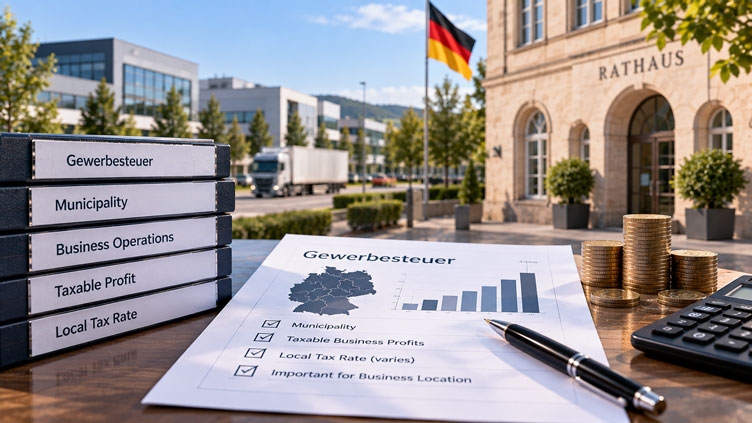
Trade tax (Gewerbesteuer) is one of the most important components of business tax in Germany.
Unlike corporate income tax, which has a nationwide rate, trade tax is a municipal tax.
This means the effective trade tax rate varies depending on the municipality in which the business operates.
Almost all commercial business operations in Germany are subject to trade tax. For corporations such as a GmbH, it is therefore an important part of the total corporate tax burden.
The calculation is based on two elements:
- the nationwide tax base rate of 3.5 percent
- the municipal multiplier (Hebesatz)
The 3.5 percent tax base rate is established by German law.
The municipality then applies its own multiplier. Trade tax is generally not deductible for corporate income tax purposes.
For example, with a municipal multiplier of 400 percent:
3.5% × 400% = 14% effective trade tax
This is why two otherwise identical companies located in different German municipalities can face different overall corporate taxation.
How High Is Trade Tax in Germany?
There is no single nationwide effective trade tax rate.
According to Germany Trade & Invest, municipalities must currently apply a multiplier of at least 200 percent. This produces a minimum effective trade tax rate of 7 percent.
The German average is slightly above 14 percent, while rates in larger cities are often higher than in smaller municipalities.
For international companies evaluating potential German locations, this is important.
The location of the registered office or permanent establishment can therefore influence the company’s total tax burden.
A difference of several percentage points can become financially significant for a business generating substantial annual profits.
What Is the Overall Corporate Tax Rate in Germany?
There is no single exact Germany corporate tax rate that applies to every company because the trade tax component varies locally.
In 2026, the total taxation of a corporation typically consists of:
15% corporate income tax
plus
5.5% solidarity surcharge on the corporate income tax
plus
municipal trade tax
Germany Trade & Invest states that the average overall corporate tax burden is approximately 30 percent.
The effective burden can be lower or higher depending mainly on the local trade tax multiplier and the company’s individual tax base.
This is one reason why international investors should not compare German business locations solely according to rent, wages or infrastructure.
Local trade tax can also affect the long-term cost of operating from a particular municipality.
Example: Calculating Corporate Taxes in Germany
Consider a simplified example of a GmbH with €1,000,000 in taxable business profit.
Assume that its municipality has a trade tax multiplier of 400 percent.
Corporate income tax
€1,000,000 × 15%:
€150,000
Solidarity surcharge
€150,000 × 5.5%:
€8,250
Trade tax
Tax base:
€1,000,000 × 3.5% = €35,000
Municipal multiplier:
€35,000 × 400% = €140,000
Total
Corporate income tax: €150,000
Solidarity surcharge: €8,250
Trade tax: €140,000
Total tax: €298,250
This corresponds to an approximate tax burden of:
29.825 percent
The example demonstrates why the commonly quoted figure of approximately 30 percent for corporate taxation in Germany is useful as an initial orientation.
Actual taxation, however, depends on the company’s individual circumstances.
How Are Foreign Corporations Taxed in Germany?
A foreign corporation does not automatically become taxable in Germany on all of its global income simply because it has German customers.
The decisive issue is the nature of its connection with Germany.
A foreign corporation may become subject to German tax on income generated inside Germany, particularly where it creates a German permanent establishment.
Examples may include a fixed place of business such as:
- an office
- branch
- factory
- workshop
- certain other permanent business facilities
Whether a specific operation creates a permanent establishment can depend on domestic German tax law as well as the applicable double taxation agreement.
Foreign companies therefore need to distinguish carefully between merely selling into Germany from abroad and establishing actual business operations within Germany.
How Are German Permanent Establishments Taxed?
A foreign company operating through a German permanent establishment can become subject to German taxation on the business profits attributable to that establishment.
Germany Trade & Invest states that German permanent establishments of foreign corporations are subject to corporate income taxation.
This can mean that a foreign company has to deal with:
- German corporate income tax
- solidarity surcharge
- trade tax
- German tax registration
- accounting obligations
- tax filings
The appropriate allocation of business profits between the foreign head office and the German permanent establishment can become a particularly important international tax question.
Companies should therefore analyze permanent establishment risks before creating fixed offices, local management structures or other substantial operations in Germany.
Subsidiary vs. Branch: Does the Legal Form Affect Taxation?
Yes.
The legal form of the German operation affects how taxation is structured.
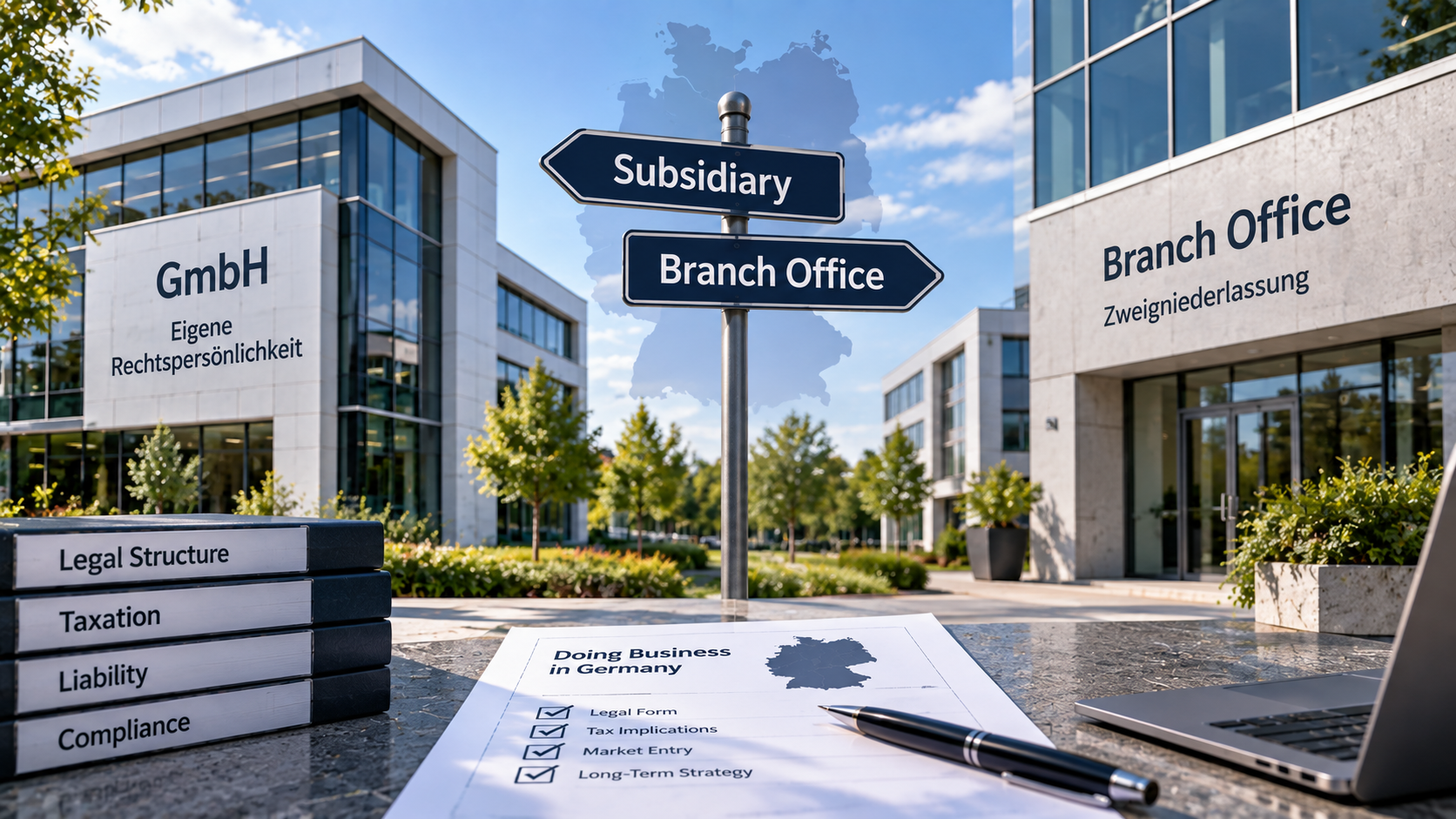
A German subsidiary such as a GmbH is a separate corporation and generally pays German taxes on its taxable corporate income.
A branch office remains part of the foreign company. However, if the branch constitutes a German permanent establishment, Germany can tax the profits attributable to that establishment.
Both structures can therefore create corporate tax obligations in Germany.
However, the accounting, profit allocation, international taxation and distribution of profits can differ substantially.
This is why companies should evaluate taxation together with legal liability and operational requirements before choosing between a German subsidiary and branch office.
Double Taxation and International Companies
International companies frequently ask whether profits could be taxed both in Germany and in their home country.
Germany maintains an extensive network of double taxation agreements designed to reduce or eliminate this risk.
Germany Trade & Invest states that Germany has entered into tax agreements with more than 90 countries.
A double taxation agreement can determine, among other matters:
- which country may tax particular income
- what constitutes a permanent establishment
- how business profits are allocated
- how dividends are taxed
- how certain interest payments are treated
- how taxes paid abroad are credited or exempted
Depending on the applicable treaty, income already taxed in Germany may receive an exemption or tax credit in the company’s home country.
The exact rules vary by country.
International companies should therefore always check the applicable double taxation agreement rather than relying on general assumptions about German taxation.
Withholding Tax in Germany
Withholding tax can become relevant when a German company makes certain payments to shareholders or other recipients.
Dividends are a common example.
The actual tax burden on cross-border distributions may be affected by:
- German domestic tax law
- European Union rules
- the recipient’s legal form
- shareholding percentage
- applicable double taxation treaties
International corporate structures should therefore consider not only taxation of the company’s operating profit but also how profits can eventually be distributed to the foreign parent company.
The after-tax return to the investor may differ from the tax rate charged at company level.

Corporate Income Tax vs. Personal Income Tax
Corporate income tax should not be confused with personal income tax.
Corporations such as a GmbH or AG generally pay corporate income tax on corporate profits.
Individuals, sole proprietors and partners in certain partnerships may instead be subject to income tax under the German Income Tax Act.
This means that the applicable income tax rate and corporate tax rate depend heavily on the company’s legal structure.
For international investors choosing a legal form, taxation at company and shareholder level should therefore be considered together.
Value Added Tax in Germany
Another major component of the German tax system is value added tax (VAT), known in Germany as Umsatzsteuer.
The standard German VAT rate is currently 19 percent.
A reduced rate of 7 percent applies to certain goods and services, while some transactions may be exempt.
VAT is fundamentally different from corporate income tax.
Corporate tax is based on company profits.
VAT is a consumption tax added to qualifying transactions involving goods and services.
Companies typically charge VAT to customers and can deduct eligible VAT paid on business purchases through the input VAT deduction system.
For example, if a company:
- charges €19,000 in VAT to customers, and
- pays €12,000 in deductible VAT to suppliers,
the difference generally payable to the tax authorities would be €7,000.
The actual rules depend on the nature and location of the transaction.
VAT and International Business
VAT becomes particularly important for companies trading across borders.
Different rules can apply to:
- domestic German transactions
- intra-EU supplies
- cross-border services
- imports from third countries
- exports
- B2B transactions
- B2C transactions
Businesses trading with other European Union member states may also need a German VAT identification number.
Germany’s Federal Central Tax Office (Bundeszentralamt für Steuern) is responsible for a number of international tax functions, including VAT identification matters.
For certain B2B transactions, a reverse-charge mechanism can apply, shifting responsibility for the VAT calculation to the business customer.
Because VAT rules depend strongly on individual transactions, international companies should establish the correct VAT processes before issuing invoices.
Input VAT Deduction
The input VAT deduction (Vorsteuerabzug) prevents VAT from becoming a cost at each stage of a normal business supply chain.
A VAT-registered company generally charges VAT on taxable sales while paying VAT on eligible business purchases.
The company then offsets deductible input VAT against the VAT collected from its customers.
Germany Trade & Invest confirms that VAT collected and VAT paid by companies can generally be balanced through the input VAT deduction mechanism.
Correct invoices and documentation are therefore extremely important.
Real Estate Taxes for Companies in Germany
Companies owning or acquiring German real estate may encounter additional taxes beyond ordinary corporate taxation.
Two particularly relevant taxes are:
- real estate transfer tax
- annual real estate tax
Real Estate Transfer Tax
Real estate transfer tax (Grunderwerbsteuer) is generally triggered when German real estate changes ownership.
The rate differs by federal state.
For 2026, Germany Trade & Invest lists rates ranging from 3.5 percent to 6.5 percent, depending on the federal state.
This means location also matters when acquiring offices, factories, warehouses or other property.
Special rules can additionally apply when shares in real-estate-owning companies change ownership.
Annual Real Estate Tax
Property owners can also be subject to annual real estate tax (Grundsteuer).
This is separate from real estate transfer tax and represents a recurring tax associated with owning real property.
Companies planning to purchase business premises should therefore include property taxation in their broader site-selection calculation.
Tax Registration for Companies in Germany
After establishing a corporation or permanent establishment in Germany, the business must normally register with the competent tax office.
According to Germany Trade & Invest, a company or permanent establishment generally has to submit the German tax registration questionnaire electronically through the ELSTER tax system within one month of establishment.
The responsible local tax authorities can then issue the company’s tax number.
Depending on the company’s activities, registrations may relate to:
- corporate income tax
- trade tax
- VAT
- wage tax
- other taxes
Foreign companies establishing German operations should therefore treat tax registration as an integral part of their market-entry process.
Corporate Tax Returns in Germany
Corporations must generally submit annual tax filings to the German tax authorities.
These may include:
- corporate income tax return
- trade tax return
- annual VAT return
- additional declarations depending on the company
Tax returns are generally filed electronically.
Under the standard German rule, calendar-year tax returns without a professional tax adviser are due seven months after the end of the relevant year. This normally corresponds to July 31 of the following year.
Different deadlines can apply where an authorized tax adviser prepares the return, and special circumstances may alter the deadline.
Germany Trade & Invest also states that companies must submit annual returns to the responsible tax authority.
International businesses should therefore establish appropriate bookkeeping and tax processes early rather than preparing German accounts only at year-end.
Corporate Tax Advance Payments
German taxes are generally not paid only once after the annual tax return.
Important business taxes can involve advance payments during the year.
These payments are later credited against the company’s final annual tax liability.
Germany Trade & Invest notes that corporate income tax, trade tax, income tax and VAT generally involve monthly or quarterly advance payments depending on the tax concerned.
For a growing foreign business, cash-flow planning should therefore include tax payments throughout the year.
Wage Tax and Employees in Germany
Foreign companies hiring employees in Germany should also consider wage tax.
German employers generally have obligations connected with:
- payroll
- wage tax withholding
- social security contributions
- payroll reporting
Wage tax is technically an employee income tax, but the employer plays an important role in calculating, withholding and transferring the amounts to the relevant authorities.
International companies establishing their first German team should therefore integrate payroll registration into the overall setup process.
Interest Expenses and Corporate Tax
German tax law contains rules affecting the deductibility of certain company expenses.
This includes rules relating to interest expenses and other financing costs.
International groups should pay particular attention where German subsidiaries are financed through intra-group loans or other cross-border financing structures.
The tax treatment of:
- interest payments
- intercompany financing
- transfer pricing
- related-party transactions
can significantly affect taxable corporate income.
Certain arrangements can trigger additions, limitations or other tax adjustments when determining the tax base.
Large multinational groups should therefore coordinate financing and transfer pricing with German tax advisers before implementing them.
Hidden Profit Distributions
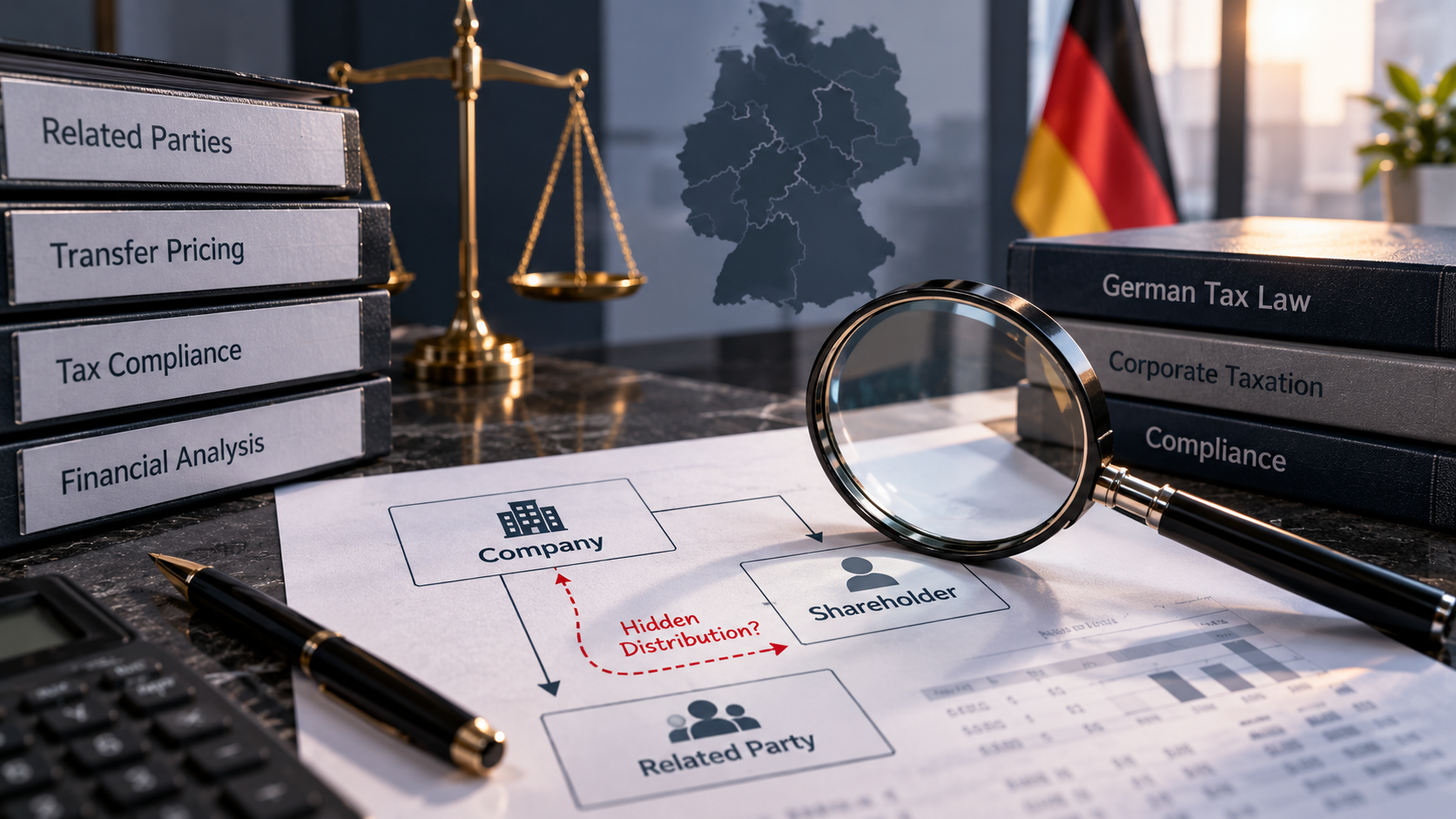
A further concept under German corporate tax law is the hidden profit distribution (verdeckte Gewinnausschüttung).
This can arise when a company provides a shareholder or related person with a benefit that would not normally have been granted to an unrelated third party under the same conditions.
Examples might include commercially inappropriate:
- payments
- asset transfers
- excessive remuneration
- rent
- financing conditions
If German tax authorities classify a transaction as a hidden profit distribution, the taxable corporate income may be adjusted.
International companies should therefore ensure that transactions between a German subsidiary and its shareholders or related companies follow commercially appropriate terms.
Why Company Location Matters for Corporate Taxes in Germany
Corporate income tax and the solidarity surcharge are nationwide.
Trade tax is not.
This means that the municipality in which a company establishes its operation can affect the effective corporate tax rate.
Consider two locations with different municipal multipliers.
Even if both companies generate exactly the same taxable profit, their local trade tax can differ.
For businesses planning:
- European headquarters
- offices
- production sites
- research facilities
- logistics operations
- sales offices
taxation can therefore be included as one factor in location analysis alongside infrastructure, workforce, office costs and market access.
The Frankfurt Rhine-Main region provides a particularly broad selection of municipalities and commercial locations surrounding one of Germany’s major international business centers.
International companies can therefore evaluate not only Frankfurt itself but also suitable locations throughout the wider Rhine-Main region.
Germany’s Corporate Tax Reform: What Changes from 2028?
International investors planning beyond the next few years should be aware of an important change.
Germany has introduced a gradual reduction of the corporate income tax rate beginning in 2028.
The current 15 percent rate applies through 2027.
It is then scheduled to decline by one percentage point each year until reaching 10 percent from 2032 onwards.
Trade tax and other taxes remain separate components, meaning the reduction does not automatically reduce the total tax burden by the same amount.
Nevertheless, Germany Trade & Invest expects the reform to reduce Germany’s combined corporate taxation significantly over the coming years.
For companies evaluating Germany as a long-term European location, the relevant tax question is therefore not only:
“What is the corporate tax rate in Germany today?”
It is also:
“How will the German corporate tax environment develop during our investment period?”
Corporate Taxes for International Companies: Key Questions Before Entering Germany
Before establishing German operations, a foreign company should clarify several tax questions.
Will the company establish a German subsidiary or permanent establishment?
This can determine the scope of German corporate taxation.
Where will the German company be located?
The municipality affects trade tax.
Will Germany be the headquarters of the European operation?
A German corporation can potentially become taxable on worldwide income, subject to international taxation rules and double tax treaties.
Will the company employ staff?
Payroll and wage tax obligations may apply.
Will the company trade within the European Union?
VAT registrations and cross-border VAT rules can become relevant.
Will profits be distributed to a foreign parent company?
Withholding tax and treaty rules should be reviewed.
Will the company own German real estate?
Real estate transfer tax and annual real estate tax may apply.
Will the German company receive intercompany financing?
Interest deduction and transfer-pricing rules should be considered.
These questions should form part of the company’s wider German market-entry strategy.
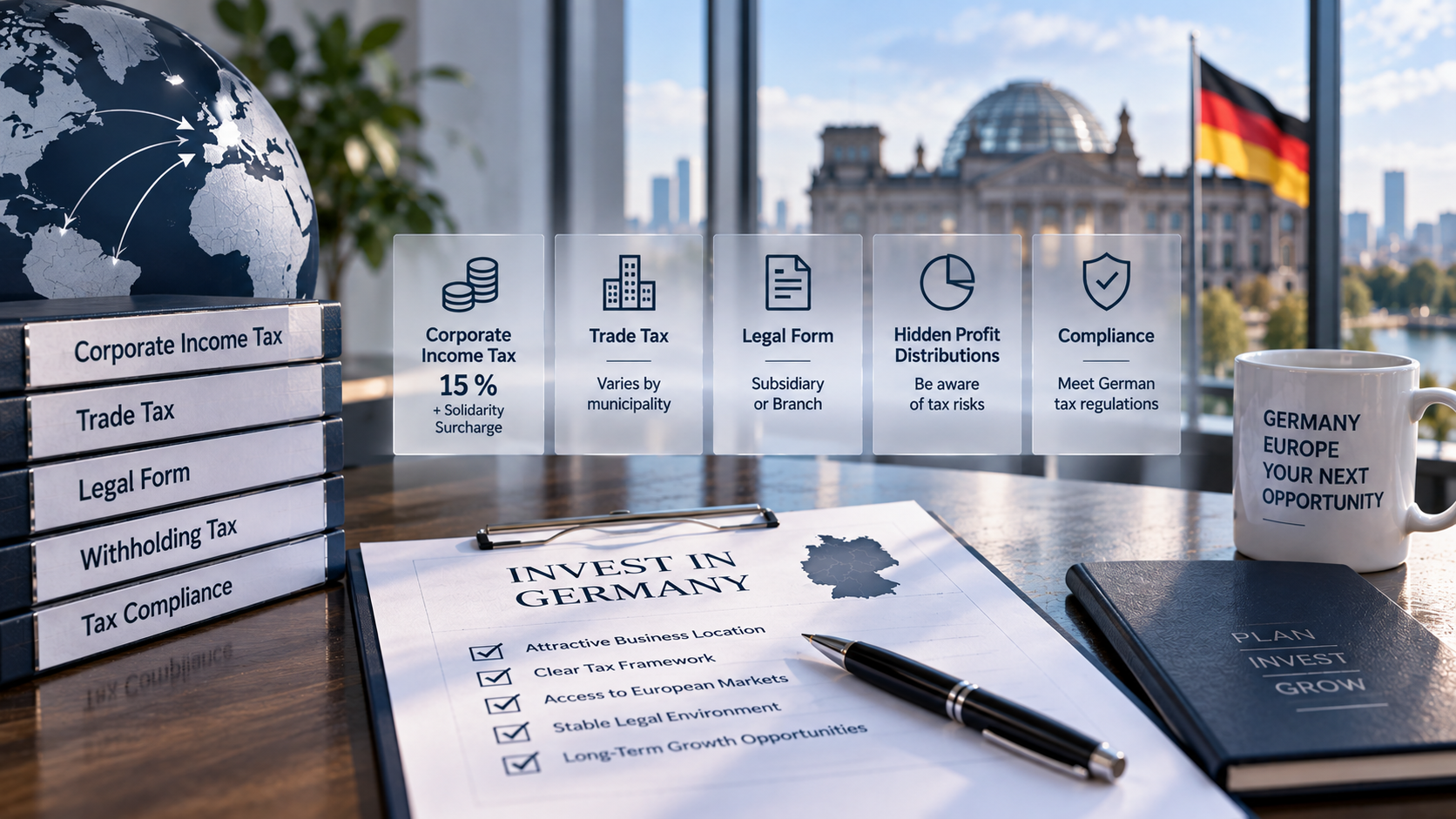
Corporate Taxes in Germany: What Foreign Investors Should Remember
For most foreign corporations entering Germany, there are several fundamental principles to understand.
German corporate taxation does not consist of a single tax.
Instead, corporate companies generally face a combination of corporate income tax, solidarity surcharge and trade tax.
In 2026:
Corporate income tax: 15%
Solidarity surcharge: 5.5% of corporate income tax
Trade tax: depends on the municipality
Average combined burden: approximately 30%
A German-based corporation can generally be taxable on worldwide income, while a foreign company without German residence can have limited tax liability on German-source income.
Germany’s extensive network of double taxation agreements can help prevent the same income from being taxed twice.
For international businesses, the biggest practical lesson is therefore that legal structure, company location and taxation should be planned together.
How the Innovation Hub RheinMain Supports Foreign Companies
For an international company, entering Germany involves significantly more than understanding the corporate income tax act or calculating a theoretical tax rate.
The company also needs to establish a functioning operation.
The Innovation Hub RheinMain supports international companies entering Germany and the European market from the Frankfurt Rhine-Main region.
Depending on the individual project, this can include support with:
- company formation
- market-entry planning
- coordination with tax advisers and legal specialists
- office and coworking solutions
- location selection
- local business networks
- HR and recruitment
- business development
- partner identification
- establishing a German market presence
For companies comparing different German locations, the Innovation Hub RheinMain can also help connect tax considerations with wider operational questions such as office availability, staffing, infrastructure and access to potential business partners.
The objective is not simply to understand corporate taxes in Germany, but to develop a viable structure for doing business successfully in Germany over the long term.
Conclusion: Understanding Corporate Taxes in Germany
Corporate taxes in Germany are based on a combination of nationwide and municipal taxation.
In 2026, corporations generally pay a 15 percent corporate income tax on taxable income, plus the solidarity surcharge and local trade tax.
The overall average corporate tax burden is currently around 30 percent, although the exact amount depends particularly on the municipality’s trade tax rate.
Foreign corporations may also become subject to German taxation when they establish a permanent establishment or generate certain German-source income.
Value added tax, withholding tax, wage tax and property-related taxes may create additional obligations depending on the company’s activities.
Germany’s double taxation agreements help coordinate taxation for internationally active companies, while the planned reduction in corporate income tax from 2028 will gradually change the country’s future tax landscape.
For foreign companies entering the market, taxation should therefore be assessed together with company structure, location, staffing and long-term European growth plans.
A well-planned German operation starts with understanding not just how much tax a company pays, but where it becomes taxable, which income forms the tax base and how the chosen location and legal form influence the overall tax burden.
This guide provides general information on company taxation in Germany and does not constitute individual tax or legal advice. Tax rules can depend on a company’s legal form, structure, activities, ownership, location and country of origin. Professional advice should be obtained for individual cases.
FAQ: Corporate Taxes in Germany
What is the corporate tax rate in Germany?
The German corporate income tax rate is 15 percent of taxable corporate income in 2026 and 2027. A solidarity surcharge equal to 5.5 percent of the corporate income tax also applies. Trade tax is charged separately at municipal level.
What is the average overall corporate tax burden in Germany?
Germany Trade & Invest states that the average overall corporate tax burden is currently around 30 percent. The actual rate varies because trade tax is determined by the municipality where the company operates.
What taxes do corporations pay in Germany?
Corporate companies generally pay corporate income tax, the solidarity surcharge and trade tax. Depending on their activities, they may also have obligations involving VAT, withholding tax, wage tax or property taxes.
What is trade tax in Germany?
Trade tax is a municipal tax on commercial business operations. A nationwide tax base rate of 3.5 percent is multiplied by a multiplier determined by the municipality. This means the effective trade tax rate varies between locations.
Does every German city have the same corporate tax rate?
No. Corporate income tax is set nationally, but local trade tax varies by municipality. As a result, the total effective corporate taxation can differ depending on the company’s location.
Are foreign companies subject to German corporate tax?
Foreign corporations can be subject to German tax on qualifying German-source income, including profits attributable to a German permanent establishment. Corporations based or managed in Germany are generally subject to corporate income tax on worldwide income, subject to applicable international tax rules.
Is a German branch subject to corporate tax?
A German branch of a foreign corporation can constitute a permanent establishment. Business profits attributable to that German permanent establishment can generally be subject to German corporate taxation.
Does Germany tax worldwide income?
Corporations based in Germany or with their management in Germany are generally subject to corporate taxation on globally generated income. Double taxation agreements and other international tax provisions can modify how foreign income is treated.
Does Germany have double taxation agreements?
Yes. Germany has an extensive network of double taxation agreements with other countries designed to prevent or mitigate double taxation of international income. Germany Trade & Invest states that Germany has concluded such agreements with more than 90 countries.
What is the VAT rate in Germany?
The standard German value added tax rate is currently 19 percent. A reduced VAT rate of 7 percent applies to certain goods and services, while some transactions are exempt.
What is the solidarity surcharge for companies?
The solidarity surcharge is 5.5 percent of the corporate income tax liability. At the current 15 percent corporate income tax rate, this adds approximately 0.825 percent of taxable income.
Do German companies have to file annual tax returns?
Yes. Companies generally submit annual tax returns electronically to the responsible tax authorities. For calendar-year returns prepared without a professional tax adviser, the standard statutory deadline is seven months after the end of the year, normally July 31 of the following year. Different deadlines can apply in other circumstances.
Do companies have to register with the German tax office?
Yes. After establishing a company or permanent establishment, businesses generally submit a tax registration questionnaire electronically through ELSTER. Germany Trade & Invest states that this generally has to be done within one month of establishment.
Will Germany reduce its corporate income tax rate?
Yes. Under current law, the corporate income tax rate is scheduled to decrease from 15 percent to 14 percent in 2028, followed by annual reductions until it reaches 10 percent from 2032 onwards.