

Hiring your first employees in Germany is a major step for any foreign company entering the German market. It shows that your business is moving from exploration to real operations. But the hiring process in Germany is more formal, regulated and documentation-driven than in many other countries. Foreign employers need to understand employment contracts, payroll, wage tax, social security contributions, working hours, vacation entitlement, anti-discrimination rules, residence permit requirements and, in some cases, approval from the Federal Employment Agency.
For companies from the European Union, the European Economic Area, Asia, North America, the UK or other third countries, the key question is not only how to find applicants. The real question is how to hire employees in Germany legally, fairly and successfully.
Germany offers strong opportunities for companies that need skilled workers, trainees, professional drivers, healthcare staff, information technology experts, engineers, sales teams, project managers, service employees or operational staff. At the same time, Germany has strict labour law, strong employee protections and detailed administrative requirements.
This guide explains the most important points for foreign companies hiring their first employees in Germany.

Why hiring in Germany is a strategic step for foreign companies
For many international companies, hiring in Germany is the point where market entry becomes serious. A local employee can support business development, customer contact, sales, project implementation, service delivery, logistics, accounting, recruitment, operations and market research.
A German employee can also help foreign employers understand local business culture, direct communication, punctuality, customer expectations, language requirements and working conditions. German workplace communication is usually direct, structured and straightforward. Punctuality is highly valued in German business culture, both in meetings and in daily work.
Hiring locally can create trust with German customers and partners. It also helps companies respond faster to the labour market, understand job search behaviour, build local networks and develop a long-term employment relationship.
Can a foreign company hire employees in Germany?
Yes, a foreign company can hire employees in Germany, but the legal setup must be clear. A company can hire employees through a German subsidiary, branch office, registered employer structure or, in some cases, through an employer of record or another compliant arrangement. The right form depends on the company’s business activities, tax position, permanent establishment risk, payroll setup and long-term market strategy.
Before hiring, foreign employers should clarify:
- Whether they need a German legal entity
- Whether their activities create a taxable presence in Germany
- How payroll and wage tax will be handled
- How social security contributions will be registered and paid
- Which employment contract model is appropriate
- Whether the employee is an EU citizen, EEA citizen or third-country national
- Whether a visa or residence permit is required
- Whether recognition of foreign qualifications is needed
- Whether the role is a regulated profession
Hiring in Germany requires adherence to strict labour laws. A foreign company should not simply use an employment contract from another country and translate it into German. German law, German payroll and German employee protections must be considered from the beginning.
Employer business number before hiring
Before a company hires employees in Germany, it usually needs an employer business number, known as a Betriebsnummer. The Federal Employment Agency explains that employers need this business number to register employees with social insurance agencies and that it can be applied for online through the Federal Employment Agency’s business number service.
This number is important for payroll, social security registration and official reporting. It is one of the first administrative steps before the first employment relationship begins.
Employment contract in Germany
An employment contract is the legal basis of the employment relationship. Employment agreements in Germany should clearly describe the position, work job description, tasks, compensation, working hours, vacation entitlement, start date, probation period, notice periods, workplace, confidentiality obligations and other relevant working conditions.
German law requires employers to provide employees with written information about essential employment terms. Under Germany’s Evidence Act, employers must document key contractual conditions. In practice, foreign companies should always prepare a proper written employment contract before the employee starts work.
A German employment contract should usually include:
- Name and address of employer and employee
- Start date of employment
- Job title and work job description
- Main tasks and responsibilities
- Place of work or remote work rules
- Working hours
- Salary and compensation structure
- Bonus or commission rules, if applicable
- Vacation entitlement
- Probation period
- Notice periods
- Confidentiality and intellectual property clauses
- Reference to collective agreements, if relevant
- Rules on sick leave and reporting obligations
- Benefits and equipment
- Data protection provisions
Contracts must be precise. German employees and courts take employment terms seriously, and unclear clauses can create legal risk for the employer.

Working hours and vacation entitlement
Standard working hours in Germany are often between 35 and 40 hours per week, depending on sector, contract and collective agreements. Working time is regulated by German law, and employers must be careful with overtime, rest periods, Sunday work and night work.
Employees in Germany are entitled to paid annual leave. The statutory minimum is 20 working days per year for a five-day work week. Many companies offer more, often 25 to 30 days, especially for skilled workers, office roles, technical staff and professional positions.
For foreign companies, it is important to understand that German employees expect clear rules on working hours, overtime compensation, vacation planning, sick leave and time recording. These points should be addressed before the employment relationship starts.
Minimum wage and compensation
Germany has a statutory minimum wage. The German Federal Statistical Office states that the statutory minimum wage has been €13.90 per hour since 1 January 2026. The Minimum Wage Commission also states that the minimum wage will rise to €14.60 from 1 January 2027.
For most skilled workers, the actual market salary is significantly higher than the minimum wage. Compensation depends on the sector, job level, region, qualifications, experience, occupational groups and competition in the labour market.
Foreign employers should benchmark salaries carefully. Underpaying employees may harm recruitment, increase turnover and damage employer branding. For visa and residence permit processes, salary levels can also be relevant, especially for skilled workers from abroad and applicants over a certain age.
Social security contributions and payroll
Employers in Germany are responsible for calculating and withholding wage tax and social security contributions. Social insurance contributions are generally shared between employer and employee. Germany Trade & Invest explains that the employer withholds and distributes social insurance contributions to the relevant institutions.
Social security in Germany usually includes:
- Health insurance
- Pension insurance
- Unemployment insurance
- Long-term care insurance
- Accident insurance
Employers must register new employees with the relevant social insurance bodies. Employees must provide information about their health insurance. In practice, a new employee usually provides a health insurance membership certificate shortly after starting employment.
Payroll must be accurate from the first month. Foreign companies should work with a German payroll provider or tax advisor before hiring, because errors in wage tax or social security contributions can create serious legal and financial consequences.
Registering employees with authorities
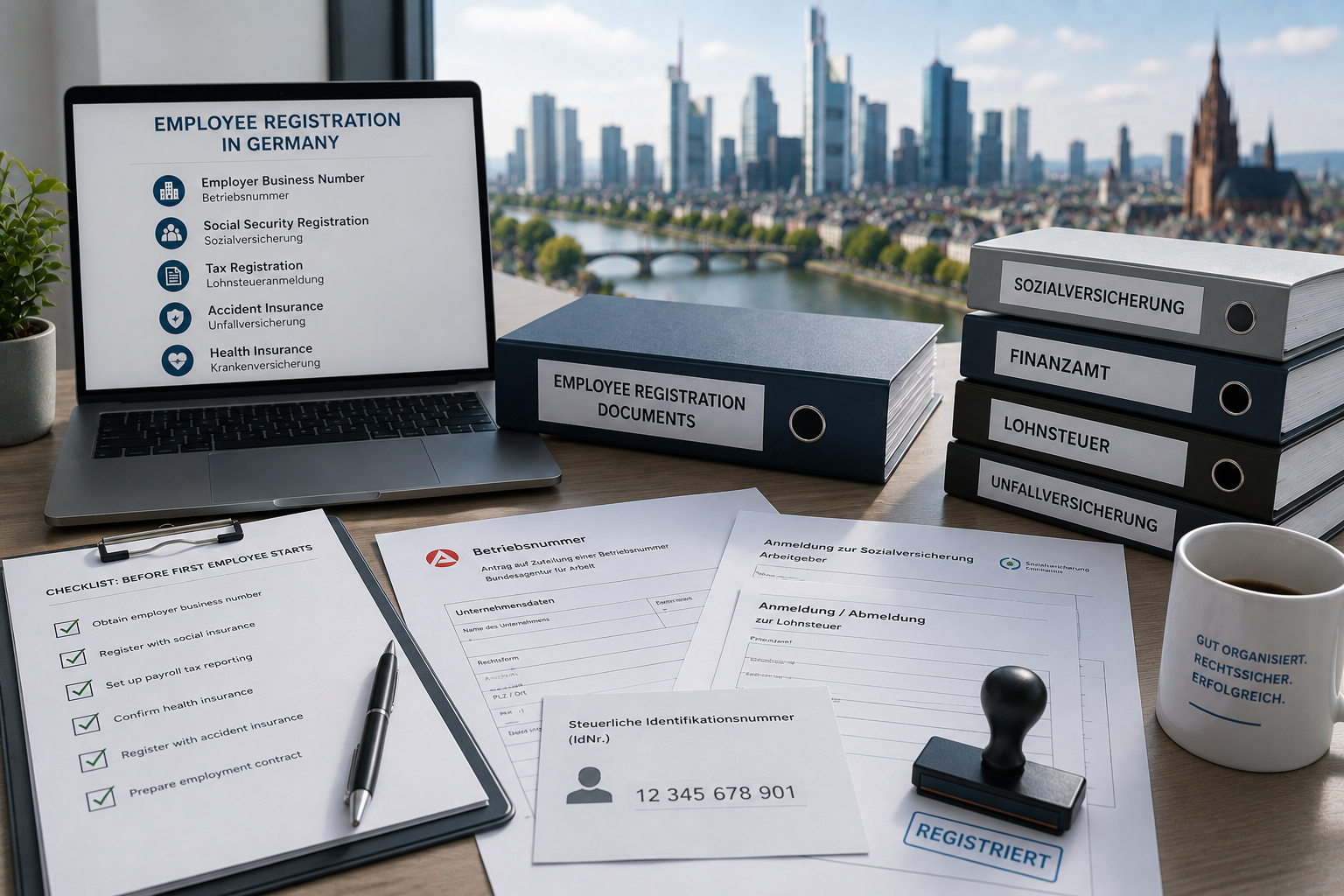
When hiring employees in Germany, employers must complete several administrative steps. These typically include obtaining an employer business number, registering the employee for social security, setting up payroll tax reporting, collecting tax identification data, confirming health insurance membership and ensuring accident insurance coverage.
New employees must be registered with social insurance bodies. Employers must also register and report wage tax through the tax system. The exact process can depend on the employer’s legal structure, payroll provider and sector.
Foreign companies should not wait until after the employee starts working. The setup should be prepared before the first working day.
Hiring EU, EEA and Swiss citizens
Citizens of the European Union and the European Economic Area generally benefit from free movement. This means they can usually enter Germany, live in Germany and work in Germany without a work visa. This makes hiring EU and EEA citizens administratively easier than hiring workers from third countries.
However, the employment relationship must still comply with German law. Employers must provide a proper employment contract, register the employee, pay social security contributions, respect working hours and comply with anti-discrimination rules.
For companies hiring from countries such as France, Ireland, Poland, Spain, Italy, North Macedonia or other European countries, it is important to distinguish between EU member states, the European Economic Area and third countries. North Macedonia, for example, is not an EU member state, so nationals from North Macedonia generally need the appropriate visa or residence permit for gainful employment in Germany.
Hiring skilled workers from abroad
Hiring skilled workers from abroad can help foreign companies and German employers deal with labour shortages. Germany has created several immigration pathways for qualified workers, vocational training graduates and professionals in shortage sectors.
Non-EU nationals generally need a valid residence title for work in Germany. German missions abroad explain that skilled workers may need a visa before entry and then a residence permit in Germany, depending on nationality and purpose of stay.
For many skilled worker routes, the applicant must have a qualification that is recognized in Germany or comparable to German professional training or an academic degree. The Federal Foreign Office states that skilled workers from abroad should get their professional qualifications recognised in Germany in good time before applying for a visa.
The application process is assessed on a case-by-case basis. Requirements can depend on the profession, country of origin, qualifications, salary, age, employer, contract, job description and whether the job is a regulated profession.
Residence permit and gainful employment
A residence permit for gainful employment allows a non-EU national to work in Germany under certain conditions. The future employer plays an important role because the visa or residence permit application usually requires a concrete job offer, employment contract or binding job description.
The documents may include:
- Valid passport
- Employment contract or binding job offer
- Work job description
- Proof of qualifications
- Recognition documents, if required
- Professional licence, if the profession is regulated
- CV and certificates
- Proof of salary
- Health insurance proof
- Visa application forms
- Further information requested by the German mission or immigration authority
Temporary work permits or employment-related residence titles may require approval from the Federal Employment Agency. The German missions and immigration authorities check the documents, and the Federal Employment Agency may assess working conditions and labour market-related requirements in certain cases.

The role of the Federal Employment Agency
The Federal Employment Agency is involved in several parts of the German hiring and immigration system. It provides labour market support, job placement services, employer services, information for companies, business number registration and, in many cases, approval for the employment of foreign workers.
For foreign employers, the Federal Employment Agency can be relevant when:
- Applying for an employer business number
- Recruiting candidates
- Checking labour market admission rules
- Hiring skilled workers from abroad
- Using public placement projects
- Obtaining approval for employment under immigration law
- Understanding vocational training and occupational groups
- Receiving free advice and further information
The Federal Employment Agency also plays a role in labour market integration and in checking whether certain foreign worker arrangements meet German standards.
Make it in Germany as a central information source
The official Make it in Germany website is one of the most important resources for employers and skilled workers from abroad. It provides extensive information on visas, residence permits, recognition of qualifications, job search, working in Germany, language courses, family relocation, vocational training and the application process.
Foreign companies should use Make it in Germany as a starting point for further information, especially when hiring non-EU skilled workers, trainees, healthcare workers, IT professionals, professional drivers or employees in shortage sectors.
The website can also help applicants understand how to enter Germany, apply online in certain procedures, prepare documents and contact the right German missions.

Recruitment agencies and private placement
Foreign companies can use recruitment agencies, private recruitment agencies or public placement services to find applicants in Germany and abroad. This can be useful when the company is hiring for the first time and does not yet understand the labour market, salary expectations, German job search platforms or local recruitment culture.
In Germany, private placement agencies generally do not need a special official certification simply to operate. However, they must comply with German law, transparency requirements and fair recruitment principles. Placement agencies must provide written contracts that detail services and fees, which is especially relevant when applicants are changing jobs or seeking new jobs through private placement agencies. For job seekers, the maximum placement fee is generally limited. The Federal Employment Agency explains that a private employment agency may charge job seekers only if a written placement contract exists and that the remuneration must not exceed €2,000 including VAT.
Foreign employers should be careful when working with agencies abroad. Ethical recruitment matters, especially in healthcare, nursing, professional drivers and other sectors where applicants may be vulnerable.
Fair recruitment and employer pays principle
Fair recruitment means that applicants are treated transparently, legally and respectfully during the recruitment process. It includes clear information, no misleading promises, fair contracts, no illegal fees, support with documents, respect for workers’ rights and ethical dealing with applicants.
The Employer Pays Principle means that employers should cover recruitment costs rather than shifting the financial burden to workers. This principle is especially important when recruiting skilled workers from abroad or dealing with private recruitment agencies.
Public placement projects in Germany generally follow ethical recruitment standards. The Federal Employment Agency is involved in labour migration projects and supports fair processes, especially where international recruitment is organized through public channels.
Fair Recruitment Healthcare Germany
The Fair Recruitment Healthcare Germany quality seal is especially relevant for healthcare recruitment. The quality seal sets standards for the fair recruitment and placement of nursing professionals from third countries into the German healthcare labour market. The seal is issued by the Kuratorium Deutsche Altershilfe Wilhelmine-Lübke-Stiftung on behalf of the Federal Ministry of Health.
The official quality seal is designed to protect healthcare workers and create transparency for employers, agencies and applicants. It covers issues such as fair information, contract transparency, integration support, language preparation, recognition procedures and the prohibition of unfair recruitment costs.
For companies and employers in healthcare, hospitals, nursing homes or care services, working with providers that follow Fair Recruitment Healthcare Germany standards can reduce reputational and legal risk. It also supports long-term integration and retention of workers.
Recognition of qualifications and regulated professions
Recognition of qualifications is a central issue when hiring skilled workers from abroad. In many cases, foreign professional training or university degrees must be recognized as equivalent to German qualifications. This is especially important for regulated professions.
A regulated profession is a profession that requires official recognition, licensing or authorization before the employee can work in Germany. Examples can include doctors, nurses, pharmacists, certain engineers, teachers and other health-related professions.
For non-regulated professions, recognition may still be useful or required for certain visa pathways. In all cases, the employer should understand whether recognition is needed before making promises to the applicant.
Foreign companies should plan enough time for recognition procedures, document translation, certified copies, German language courses and authority communication.

Hiring trainees and vocational training candidates
Germany’s vocational training system is an important route for developing skilled workers. Foreign companies can hire trainees if they meet the requirements and provide appropriate training conditions. Applicants from abroad may need a visa or residence permit for vocational training.
Vocational training can be useful in sectors with long-term labour shortages, such as healthcare, technical trades, logistics, industrial production, hospitality, professional drivers and other occupational groups.
However, hiring trainees requires structure. The employer must provide qualified supervision, clear training content, fair compensation, working conditions and compliance with vocational training law.
Hiring professional drivers
Professional drivers are one of the occupational groups where Germany has strong labour market demand. Hiring professional drivers from abroad can be possible, but employers must check visa requirements, driving licence recognition, professional driver qualifications, language skills, employment contract terms and working time rules.
A foreign driving licence may need to be recognized or converted, depending on the country of issue. Additional qualifications may be required for commercial transport. Employers should also consider road safety, working conditions, insurance, rest periods and tachograph rules.
Because the requirements can differ by country and job type, applications should be checked on a case-by-case basis.
Anti-discrimination rules in the hiring process
The General Equal Treatment Act prohibits discrimination in hiring. Employers must avoid discrimination based on characteristics such as age, gender, disability, ethnic origin, religion, belief or sexual identity.
This affects job advertisements, interviews, selection criteria, rejection letters and documentation. The hiring process should follow objective criteria. Job descriptions should focus on tasks, qualifications, experience, language skills, working conditions and professional requirements.
Foreign companies should train hiring managers and recruitment agencies to avoid inappropriate questions or discriminatory wording. This is especially important when hiring in Germany for the first time.
Works council and employee representation
In companies with five or more employees, staff can elect a Works Council if the legal requirements are met. A Works Council is an employee representation body with consultation and co-determination rights in many workplace matters.
For small foreign companies hiring their first employee, this may not be immediately relevant. But as the company grows, employee representation can become important. Employers should understand that German workplace culture includes formal employee participation rights, especially in larger operations.
Probation period and dismissal protection
Germany has strong employee protections regarding dismissal and probation periods. Many employment contracts include a probation period of up to six months. During probation, shorter notice periods can apply.
After the employee has worked for more than six months and if the employer has more than ten employees in Germany, the German Dismissal Protection Act may apply. This means dismissals must be socially justified, for example for operational, conduct-related or personal reasons.
Foreign companies should not assume that employment can be ended at will. German law is protective, and mistakes in dismissal procedures can be costly.
German business culture in employment
Hiring in Germany is not only a legal process. It is also a cultural process. German employees often value clarity, reliability, punctuality, structured communication, fair compensation, transparent tasks and predictable working conditions.
Employers should provide clear job descriptions, realistic expectations, structured onboarding, written documentation and direct feedback. German workplace communication can be more direct than in some other cultures, but this is often intended to create clarity and efficiency.
For foreign companies, adapting to German employment culture can improve retention, productivity and trust.
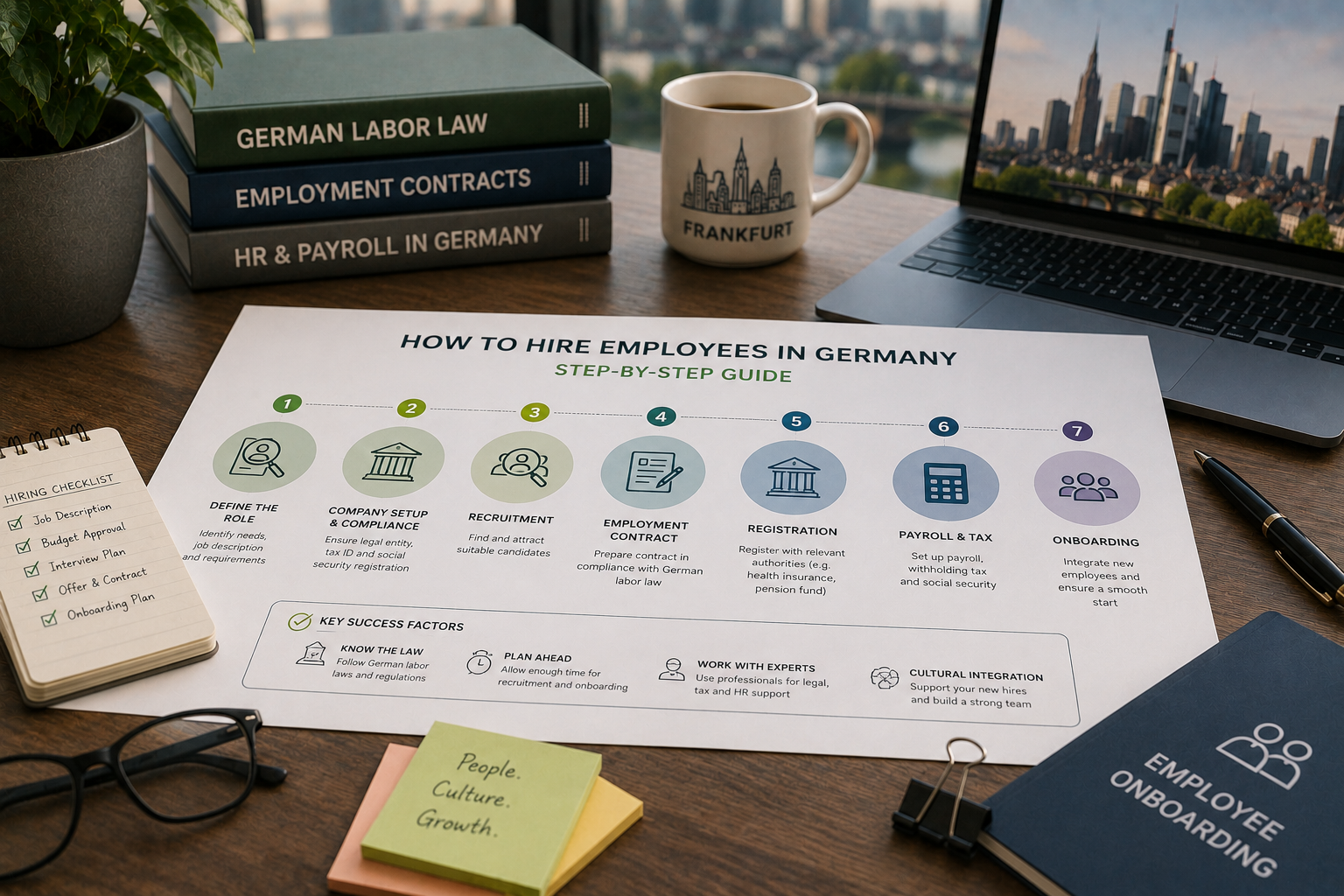
Step-by-step guide: How to hire employees in Germany
Step 1: Define the role
Prepare a clear work job description. Define tasks, qualifications, language skills, working hours, compensation, location, remote work options and reporting lines.
Step 2: Check the legal employer setup
Decide whether you hire through a German entity, branch, employer of record or another compliant structure. Clarify tax, payroll and permanent establishment risks.
Step 3: Obtain an employer business number
Apply online for the employer business number through the Federal Employment Agency before registering employees for social security.
Step 4: Prepare the employment contract
Create a German-law compliant employment contract. Include job title, responsibilities, salary, working hours, vacation entitlement, probation period and notice rules.
Step 5: Recruit candidates
Use job boards, recruitment agencies, private recruitment agencies, public placement, professional networks, universities, industry groups and direct sourcing.
Step 6: Follow fair recruitment and anti-discrimination rules
Use objective selection criteria. Avoid discriminatory questions and wording. Provide transparent information to applicants.
Step 7: Check visa and residence permit requirements
For EU and EEA citizens, work authorization is usually straightforward. For third-country nationals, check visa, residence permit, qualification recognition and Federal Employment Agency approval requirements.
Step 8: Register the employee
Register the employee with social insurance bodies, payroll tax systems and relevant authorities. Collect health insurance and tax information.
Step 9: Set up payroll
Calculate salary, wage tax and social security contributions. Work with a German payroll provider to avoid compliance errors.
Step 10: Onboard the employee
Provide equipment, access, training, policies, language support if needed, and clear expectations for the first weeks.
How to hire employees in Germany as a foreign company
To hire employees in Germany, a foreign company must set up a compliant employer structure, obtain an employer business number, prepare a written employment contract, follow German labour law, register employees with social security and payroll tax authorities, and withhold wage tax and social security contributions.
EU and EEA citizens can generally work in Germany under free movement rules, while non-EU nationals need a valid visa or residence permit for gainful employment. Hiring skilled workers from abroad may require recognition of qualifications, approval from the Federal Employment Agency and documents such as a job offer, employment contract and work job description.
Employers should follow fair recruitment principles, especially in healthcare, where the Fair Recruitment Healthcare Germany quality seal supports ethical recruitment from third countries.
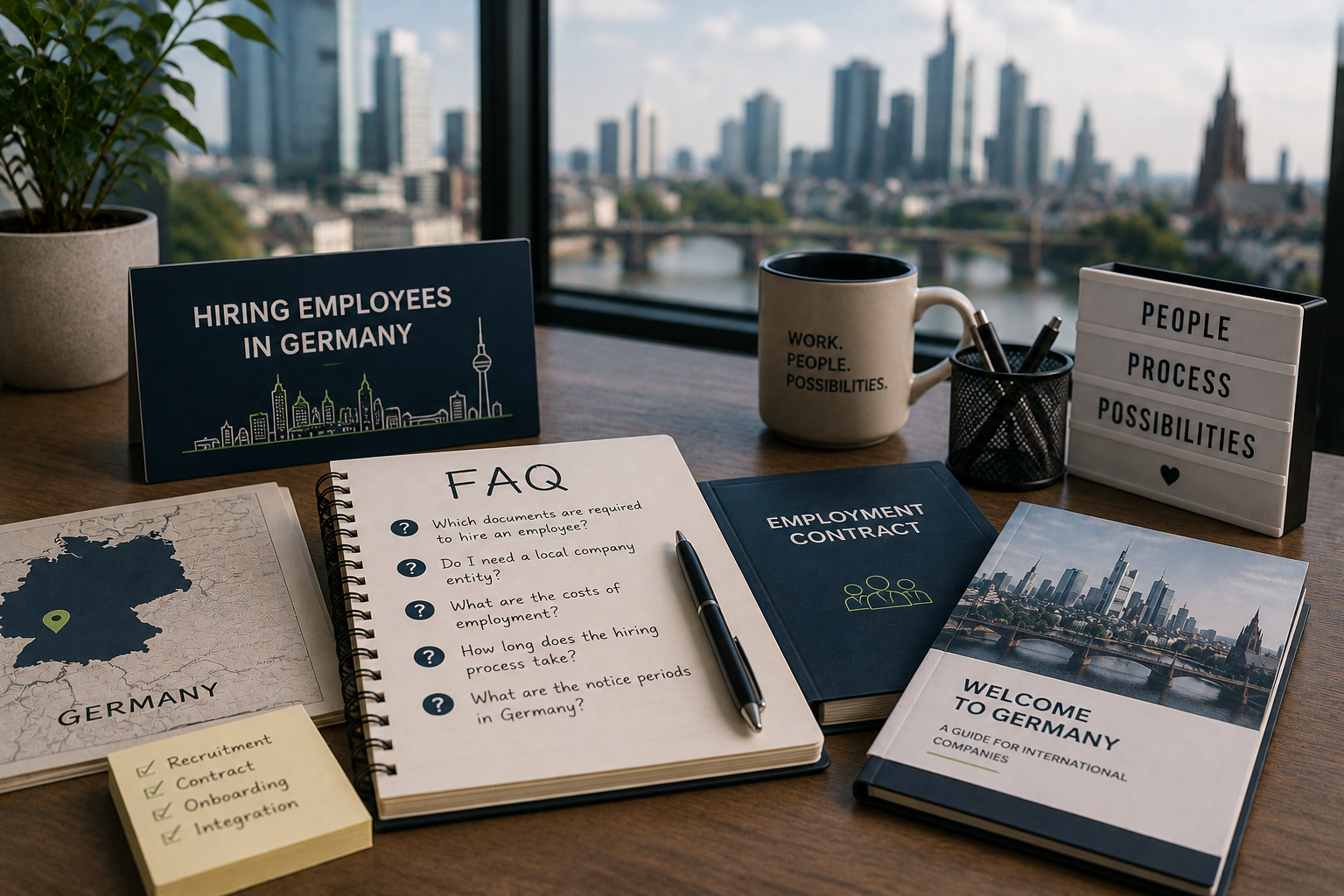
FAQ: Hiring employees in Germany
Can a foreign company hire employees in Germany?
Yes. A foreign company can hire employees in Germany if it uses a compliant employer structure, sets up payroll, registers employees correctly and follows German employment law.
What do I need before hiring my first employee in Germany?
Before hiring your first employee in Germany, you usually need a legal employer setup, an employer business number, payroll registration, a German-law compliant employment contract and a process for social security contributions and wage tax.
Does an employment contract in Germany need to be in writing?
Employers must provide written information about essential employment terms. In practice, foreign companies should always use a written employment contract that defines job title, responsibilities, salary, working hours, vacation, probation period and notice periods.
What is the minimum wage in Germany in 2026?
The statutory minimum wage in Germany is €13.90 per hour from 1 January 2026. It is scheduled to rise to €14.60 from 1 January 2027.
How much paid vacation do employees receive in Germany?
Employees in Germany are entitled to at least 20 paid working days of annual leave for a five-day work week. Many employers offer more, often between 25 and 30 days.
Do employers pay social security contributions in Germany?
Yes. Employers are responsible for withholding and paying social security contributions. These contributions are generally shared between employer and employee and cover health, pension, unemployment, long-term care and accident insurance.
Do non-EU nationals need a visa to work in Germany?
Yes. Non-EU nationals generally need a valid visa or residence permit for gainful employment in Germany. Requirements depend on nationality, qualifications, job offer, salary, profession and individual circumstances.
What role does the Federal Employment Agency play?
The Federal Employment Agency provides labour market services, employer support, business number registration and, in certain cases, approval for employment of foreign workers. It can also be involved in public placement and fair recruitment projects.
What is Fair Recruitment Healthcare Germany?
Fair Recruitment Healthcare Germany is an official quality seal for fair recruitment and placement of nursing professionals from third countries into the German healthcare labour market. It sets standards for ethical recruitment, transparency and worker protection.
Can recruitment agencies charge applicants in Germany?
Private employment agencies may charge job seekers only under strict conditions, including a written placement contract. The fee must not exceed €2,000 including VAT.
Are private recruitment agencies in Germany officially certified?
Private recruitment agencies generally do not need special certification simply to operate. However, employers should choose reputable agencies and ensure that fair recruitment, transparency and legal requirements are followed.
What is a regulated profession in Germany?
A regulated profession is a profession that requires official recognition or authorization before the employee can work in Germany. Examples include many healthcare professions, such as doctors and nurses.
Do companies need to follow anti-discrimination rules when hiring?
Yes. The German General Equal Treatment Act prohibits discrimination in hiring. Employers should use objective criteria and avoid discriminatory questions, wording or selection practices.
What is the best first step for a foreign company hiring in Germany?
The best first step is to define the role clearly, check the employer setup, obtain advice on German employment law and payroll, and prepare a compliant employment contract before starting recruitment.
Conclusion: hiring in Germany requires planning, compliance and fairness
Hiring your first employees in Germany is a major opportunity for a foreign company. Local employees can create access to customers, improve business development, support operations, strengthen trust and make the German market easier to understand.
At the same time, hiring in Germany requires careful preparation. Employers must understand employment contracts, working hours, vacation, social security contributions, payroll, wage tax, anti-discrimination rules, residence permit requirements and the role of the Federal Employment Agency.
For EU and EEA citizens, hiring is usually easier because of free movement. For skilled workers from abroad and applicants from third countries, employers must check visa, residence permit, qualification recognition and approval requirements on a case-by-case basis.
A successful hiring strategy in Germany combines legal compliance, fair recruitment, clear documentation, competitive compensation, good working conditions and strong onboarding. For foreign companies, this is not just an administrative task. It is the foundation for sustainable growth in Germany.