
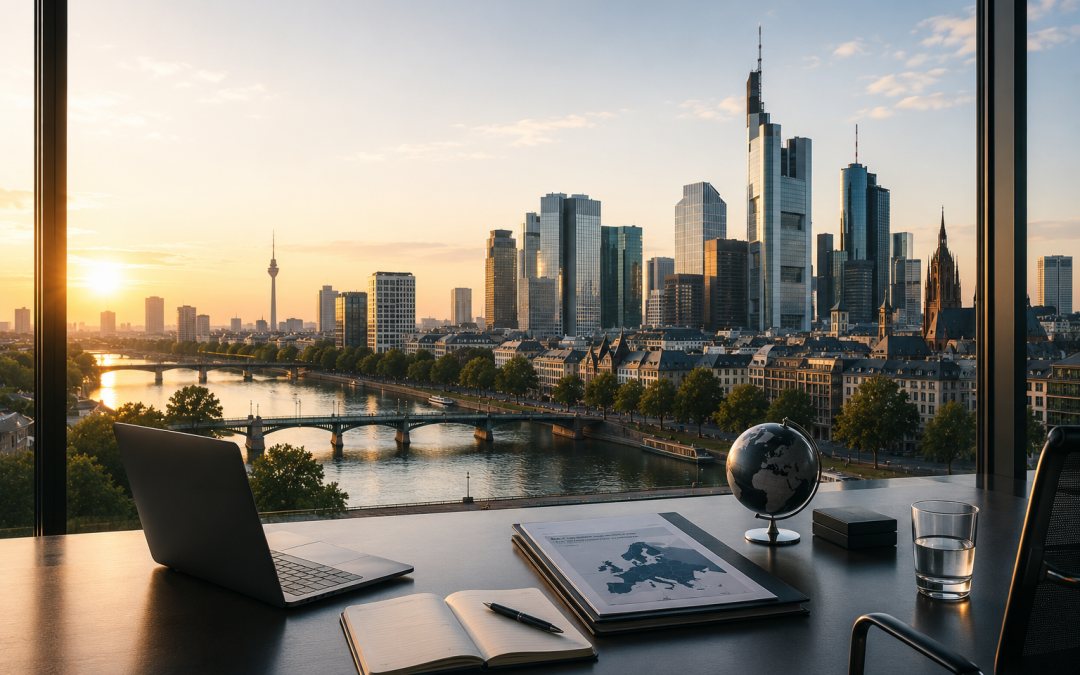
A European headquarter is the central corporate hub for a company’s business activities in Europe, bringing together leadership, accounting, finance, legal coordination, human resources, sales, research, operations, market development and coordination between the global parent company and European country teams. Choosing the right European headquarter is one of the most important strategic decisions for global companies, investors and leadership teams expanding into Europe, because the location shapes market access, operational efficiency, talent recruitment, regulatory compliance and long-term growth across the EU market.
For many international companies from Asia, North America, the UK, Switzerland, Ireland, France, Belgium and other areas of the world, the Frankfurt Rhine-Main region offers a rare combination: a central location in Germany, direct access to the European Union, strong infrastructure, global connectivity, a highly developed business ecosystem, leading universities, financial institutions, research networks and one of the most international populations in Germany.
The Frankfurt Rhine-Main region has around 5.9 million people and connects many towns and cities across a powerful metropolitan region in the heart of Europe. Official regional sources describe Frankfurt-Rhein-Main as a region with more than 5.9 million people, and the broader metropolitan structure includes hundreds of towns and cities. This article explains what a European headquarters does and why companies choose Frankfurt-Rhine-Main, including its location, infrastructure, EU access, the role of the European Central Bank, legal and tax factors, talent, industry clusters, Brexit effects and how the region compares with other European cities.
What is a European headquarter?
A European headquarter is the central corporate hub for a company’s business activities in Europe. It often manages leadership, finance, accounting, HR, legal affairs, sales strategy, marketing, supply chain coordination, customer success, compliance, reporting and communication between the global parent company and European country teams.
A European headquarter can support operations in Germany, France, Ireland, Belgium, Switzerland, the UK, Southern Europe, Northern Europe, Eastern Europe and other EU countries. It helps companies consolidate leadership and operational support for regional management. Centralizing functions at a European headquarters can improve organizational efficiency, reduce duplicated structures, support faster decision-making and create a clearer market strategy.
For a global company, the aim is usually not just to open a new entity. The aim is to build a stable platform for growth in Europe.
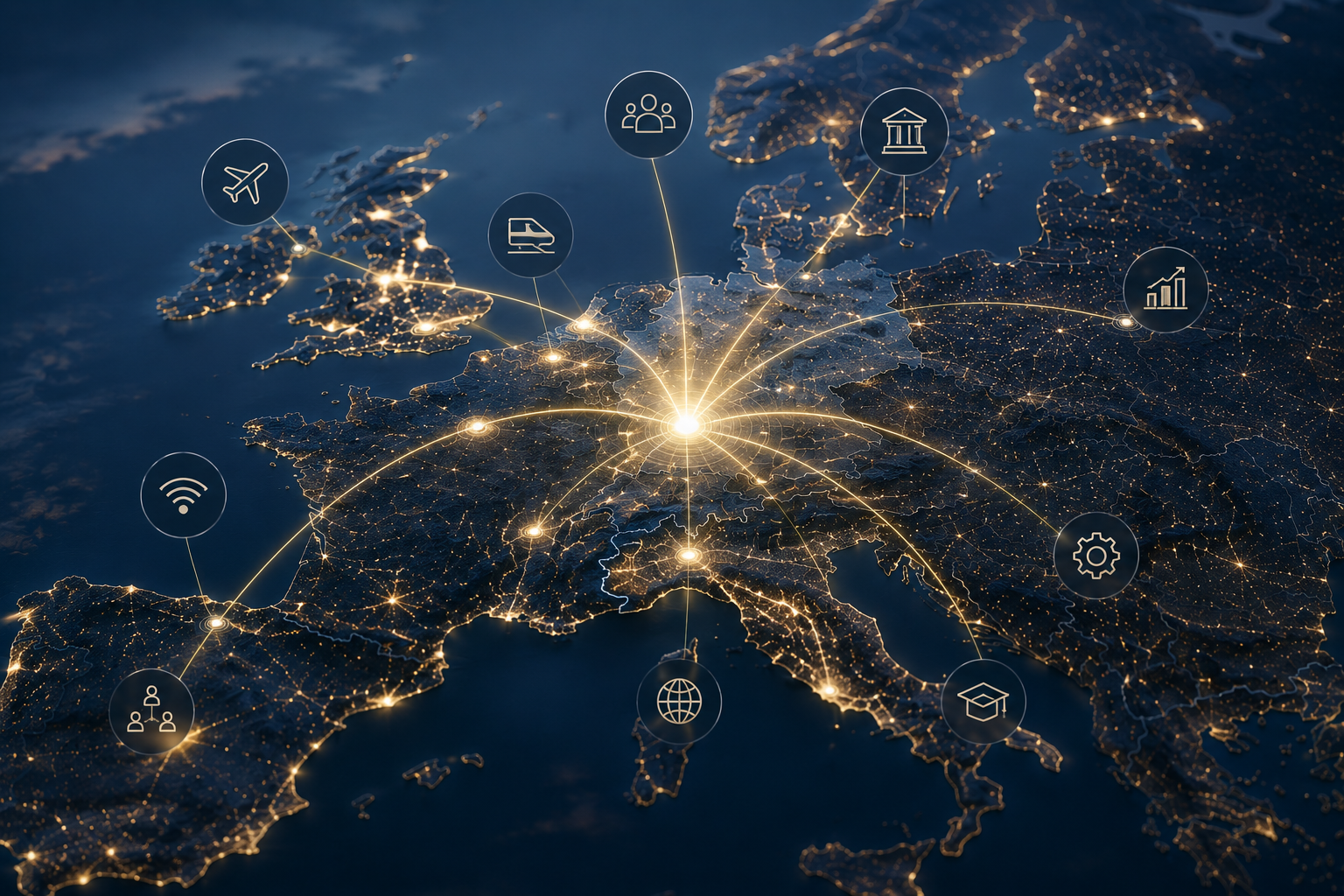
Why Frankfurt Rhine-Main is a strong European headquarter location
The Frankfurt Rhine-Main region is one of the most important economic regions in Europe. It combines finance, logistics, technology, pharmaceuticals, automotive suppliers, consulting, research, trade fairs, universities, international services and strong transport infrastructure.
Frankfurt is located in the middle of Germany and Europe. This central location gives companies easy access to customers, suppliers, investors, institutions and other markets. From Frankfurt, companies can reach major business regions in Germany, France, Belgium, the Netherlands, Switzerland, Austria, Northern Italy and other EU countries quickly.
For international groups, proximity to major customers and suppliers enhances effective regional management. Transportation infrastructure is critical for coordinating operations across Europe, and this is where Frankfurt Rhine-Main has a clear advantage.
Frankfurt as the home of the European Central Bank
One of the strongest signals of Frankfurt’s European importance is the presence of the European Central Bank. The ECB is headquartered in Frankfurt am Main, Germany, with its main premises at the Sonnemannstrasse in the city.
The European Central Bank gives Frankfurt a unique position among European Union institutions. While many EU institutions and European Union institutions are located in Brussels, Strasbourg and Luxembourg, Frankfurt is the city of the euro’s central monetary institution. This strengthens Frankfurt’s profile as a finance, banking, regulation and policy-related business location.
For companies in finance, fintech, insurance, accounting, legal services, consulting, data infrastructure and other regulated sectors, the presence of the European Central Bank adds strategic importance. It also reinforces Frankfurt’s identity as a European decision-making site, even though not all EU institutions are located in one city.
Frankfurt Rhine-Main and the European Union framework
A European headquarter in Frankfurt Rhine-Main gives companies access to Germany and the broader European Union. The EU framework matters because it shapes market access, product rules, data protection, competition law, employment mobility, environmental regulation, customs, consumer protection, digital regulation and free movement.
The EU single market provides companies with a home market of more than 450 million consumers and easier access to suppliers and customers across EU countries. For a company from Asia, the UK, the US or another country outside the EU, a European headquarters in Germany can therefore become a bridge into the single market.
The European Union is shaped by several institutions and bodies, including the European Commission, the European Parliament, the European Council, the Council of the EU, the Court of Justice of the European Union, the General Court, the European Court of Auditors and the European Central Bank. These institutions influence legislation, security policy, economic regulation, competition rules and the development of the EU market, shaping the present EU legal and regulatory environment for companies.
EU institutions: why they matter for companies
Global companies do not need to be located next to every EU institution, but they do need to understand the system. The European Commission proposes legislation and monitors implementation. The European Parliament represents EU citizens and is involved in lawmaking. The European Council brings together EU leaders and sets political priorities. The Court of Justice of the European Union interprets EU law and ensures that it is applied consistently in all EU countries.
The Court of Justice of the European Union is based in Luxembourg and includes the Court of Justice and the General Court. It interprets EU law, settles legal disputes between national governments and EU institutions, and can under certain conditions be used by companies or organisations to challenge an EU institution. The European Parliament welcomes visitors in Brussels, Strasbourg and Luxembourg, reflecting the distributed nature of European Union institutions.
For companies, this institutional landscape is important because European operations are shaped by both EU law and national law. A headquarters in Frankfurt Rhine-Main places a company in Germany, Europe’s largest economy, while still providing practical access to Brussels, Luxembourg, Strasbourg, Berlin, Paris and other decision-making centers.
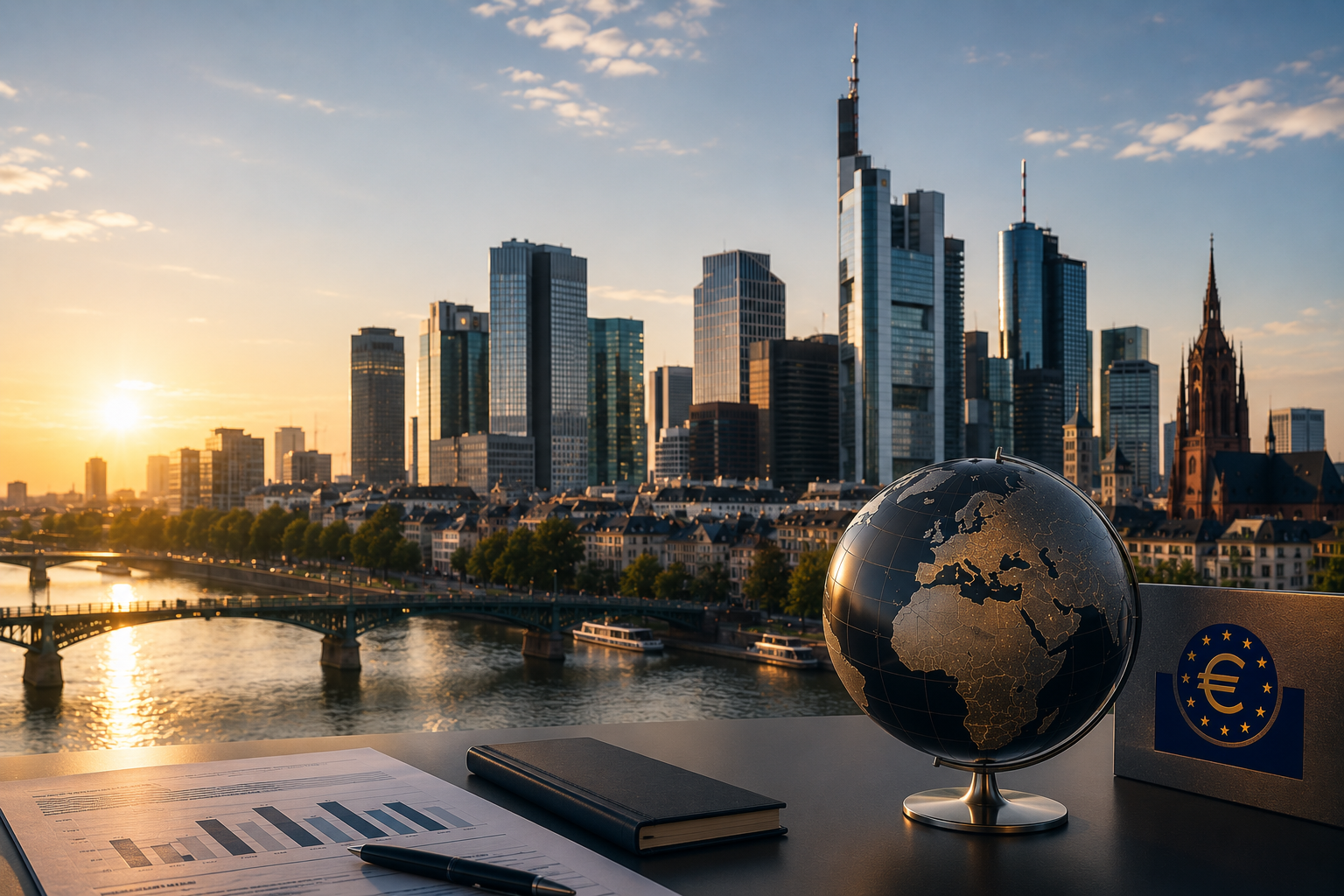
Germany as Europe’s largest economy
Germany remains Europe’s largest economy and one of the most important business countries in the world. According to KPMG’s economic key facts, Germany had a GDP of €4,470 billion in 2025, making it the world’s third-largest economy and Europe’s largest economy.
For global companies, this matters because Germany is not only a headquarter location. It is also a major market in its own right. Companies can build sales, partnerships, research projects, service structures and investment activities in Germany while using the country as a base for European expansion.
Frankfurt Rhine-Main benefits from this position because it combines national strength with international reach. The region is located between Germany’s political capital Berlin, industrial regions in the south and west, European markets in France and Belgium, and global routes to Asia, North America and the rest of the world.
Frankfurt Airport: global access for headquarter operations
Frankfurt Airport is one of the strongest arguments for a European headquarters in the region. It is Germany’s largest airport and one of Europe’s major passenger and cargo hubs. Fraport reported that Frankfurt Airport welcomed approximately 63.2 million passengers in 2025, representing year-on-year growth of around 2.6%.
For headquarters teams, this access matters every day. Executives, sales teams, technical experts, investors and customers need reliable connections. A company with operations across Europe, Asia, the UK, North America and the Middle East benefits from a site that supports frequent international travel.
This is especially important for companies managing production, distribution, sales teams, customer projects, finance operations, legal coordination and business development across several countries.
Digital infrastructure: Frankfurt as a global internet hub
Frankfurt is not only a finance and transport hub. It is also a digital infrastructure hub. DE-CIX Frankfurt describes itself as the world’s leading internet exchange, with more than 18 terabits per second peak traffic and access to more than 1,000 local, regional and global networks.
For companies in information technology, cloud services, cybersecurity, software, fintech, artificial intelligence, data-driven services and digital platforms, this is a major advantage. A European headquarter needs stable, scalable and high-performance digital infrastructure. Frankfurt’s internet exchange ecosystem supports data connectivity, low latency, cloud operations and digital business development.
This makes the Frankfurt Rhine-Main region especially attractive for technology companies from Asia, the US, the UK, Ireland, Switzerland and other international markets.
Talent, universities and research in the Rhine Main Metropolitan Region
Access to a highly skilled workforce is essential when choosing a European headquarter. The Rhine Main metropolitan region offers universities, research institutions, business schools, technical talent, multilingual professionals and international communities.
Companies need people for finance, accounting, IT, research, sales, legal support, HR, operations, product management, logistics and customer service. Frankfurt Rhine-Main offers access to talent from Germany, Europe and the rest of the world. Its international population also helps companies attract employees who can work across languages, cultures and markets.
High quality of life in cities and towns across the metropolitan region can support employee retention. For international employees, Frankfurt Rhine-Main offers international schools, cultural diversity, airport access, strong public transport, urban centers and quieter residential areas in the north, south, east and west of the region.

Industry clusters: finance, automotive, pharmaceuticals and technology
A headquarter location becomes more powerful when it is surrounded by relevant business ecosystems. The Frankfurt Rhine-Main region is known for finance, automotive suppliers, pharmaceuticals, chemicals, consulting, logistics, information technology, research, trade fairs and professional services, and it supports innovation across sectors through its mix of research, manufacturing, technology and business services.
For finance and fintech companies, Frankfurt is a natural choice because of the European Central Bank, the German Bundesbank, financial institutions, regulatory expertise and banking talent. For pharmaceutical and healthcare companies, the wider region offers access to research, manufacturing, logistics and international markets. For automotive and mobility companies, Frankfurt Rhine-Main is connected to major German industrial regions and suppliers.
A business ecosystem with industry clusters creates networking opportunities, supplier access, investment channels, expert services and co-development potential. This is a key reason why global companies choose Frankfurt Rhine-Main for European headquarter operations.
Why UK companies look at Frankfurt Rhine-Main after Brexit
Since the UK left the European Union, many UK companies have had to rethink their European market access. A company based only in the UK may face more complexity when serving EU customers, depending on sector, structure, regulation and business model. Establishing a new entity in Germany can help certain companies maintain closer access to the EU market.
Germany Trade & Invest reported that the number of British companies setting up in Germany increased by 20% in 2022. It also noted that, in the five years since the UK left the EU, British investment climbed to third overall, behind only the USA and nearly even with Switzerland.
For UK companies, Frankfurt Rhine-Main can be especially attractive because of finance, legal services, accounting expertise, international connectivity, English-speaking business environments and proximity to EU institutions and customers.
Comparing Frankfurt with other European headquarter locations
Global companies often compare Frankfurt with Berlin, Paris, Amsterdam, Dublin, Brussels, Luxembourg, Zurich, Munich, Milan or other European cities. Each location has strengths.
Berlin offers a startup ecosystem and political proximity. Paris provides access to France, luxury, technology, industry and national institutions. Dublin is attractive for certain technology and tax-driven headquarters structures. Brussels offers proximity to EU institutions. Luxembourg is important for finance, funds and legal structures. Switzerland offers stability but is outside the European Union. Ireland has advantages for some multinational groups, but it is geographically less central than Germany.
Frankfurt Rhine-Main stands out because it combines central location, infrastructure, finance, airport access, digital connectivity, quality of life, EU market access, German economic strength and a highly international business environment.
Choosing a European headquarter requires balancing operational costs, talent availability, tax considerations, market proximity, infrastructure, legal stability and customer access. Frankfurt is not always the cheapest location, but it offers a strong combination of strategic advantages.
Setting up a new entity in Germany
Many companies that choose Frankfurt Rhine-Main establish a German company, often a GmbH. A GmbH is a common limited liability company structure in Germany. Germany Trade & Invest states that a GmbH requires minimum share capital of €25,000, with at least half of the minimum capital paid in at the time of registration.
Setting up a new entity usually involves choosing the legal form, preparing articles of association, notarization, commercial register entry, tax registration, opening a bank account, accounting setup and, if needed, hiring employees. Companies should also consider corporate taxation, trade tax, transfer pricing, VAT, employment law and compliance requirements.
Corporate tax rates can influence headquarter decisions. Germany Trade & Invest explains that corporations are subject to corporate income tax at a flat nationwide rate of 15%, while the overall corporate tax burden also includes solidarity surcharge and trade tax. The effective burden depends on the municipality and business structure, so companies should compare costs carefully before choosing a site.
Frankfurt Rhine-Main as a central point for European operations
A European headquarters should support operations across different markets. Frankfurt Rhine-Main is well suited for this because it is centrally located, internationally connected and economically diverse.
From a headquarters in Frankfurt, companies can coordinate teams in Germany, France, Belgium, the Netherlands, Austria, Switzerland, Ireland, the UK, Southern Europe, Northern Europe and Eastern Europe. The region offers easy access by air, rail and road, making it practical for regional meetings, sales visits, customer projects and supplier coordination.
For a company from Asia, Frankfurt can serve as a gateway to Europe. For a company from the UK, it can support post-Brexit EU operations. For a company from the US, it can become a central base for European growth. For companies from Switzerland, Ireland or France, Frankfurt can add German market access and European financial credibility.
The importance of stability and institutional support
Stable political and economic environments reduce long-term business risks. Germany is known for legal certainty, institutional support, strong chambers of commerce, investment promotion agencies, industry associations and a developed professional services market.
Companies investing in Frankfurt Rhine-Main can access supported business setup and growth processes through regional institutions, promotion agencies, universities and business networks, alongside help with site selection, permits, recruitment, financing, research cooperation and market information. This support is especially valuable for international companies that are entering Germany for the first time.
The combination of public institutions, private advisors, universities, business groups and international networks helps companies move from planning to establishment and from establishment to growth.
Historical context: Europe, institutions and integration
The importance of Frankfurt Rhine-Main as a European headquarter location is also connected to the history of European integration. The Schuman Declaration of 9 May 1950 is widely seen as a foundational moment of European cooperation. From past treaties and milestones to the current single-market framework, the Treaty of Rome, signed on 25 March 1957, established the European Economic Community. The Maastricht Treaty entered into force on 1 November 1993 and formally established the European Union.
The European Parliament held its first direct elections in 1979. This transition also created the current European legal and institutional environment for business. The Lisbon Treaty entered into force on 1 December 2009 and reshaped important parts of the EU framework. In 2012, the EU received the Nobel Peace Prize for its contribution to peace, reconciliation, democracy and human rights in Europe.
For companies, this history matters because the European Union is not only a market. It is a developed legal, political and institutional system. A European headquarter must operate within that system and use its advantages strategically.

Practical criteria for choosing a European headquarter
A company choosing a European headquarter should evaluate several criteria:
- Market access and proximity to customers
- Central location within Europe
- Access to the European Union single market
- Availability of skilled talent
- Quality of transport infrastructure
- Digital connectivity and data infrastructure
- Legal and political stability
- Corporate tax and operational costs
- Availability of office space and sites
- Research and university cooperation
- Industry clusters and business networks
- Quality of life for international employees
- Access to finance, accounting, legal and consulting services
- Ability to manage operations across EU countries and non-EU markets
Frankfurt Rhine-Main performs strongly across many of these criteria. It gives global companies a central point for coordination, a credible German presence, a European financial profile, access to the EU market and a practical base for growth.
Why do companies choose Frankfurt Rhine-Main for European headquarter?
Global companies choose Frankfurt Rhine-Main for European headquarter because the region combines central location, access to Germany and the European Union, strong transport infrastructure, Frankfurt Airport, the European Central Bank, world-leading internet connectivity, a skilled workforce, universities, research networks, finance expertise, industry clusters, international population and high quality of life.
A European headquarter in Frankfurt Rhine-Main can support sales, accounting, finance, HR, legal, operations, business development and regional management across EU countries, the UK, Switzerland, France, Ireland, Belgium, Asia and the rest of the world.
FAQ: European headquarter in Frankfurt Rhine-Main
What is a European headquarter?
A European headquarter is the central corporate hub for a company’s European operations. It often manages leadership, finance, accounting, legal affairs, HR, sales, business development, market strategy and operational support across Europe.
Why do companies choose Frankfurt Rhine-Main for European headquarter?
Companies choose Frankfurt Rhine-Main because of its central location, strong infrastructure, Frankfurt Airport, the European Central Bank, digital connectivity, skilled workforce, universities, business ecosystem and easy access to the EU market.
Is Frankfurt part of the European Union institutional landscape?
Yes. Frankfurt is home to the European Central Bank, one of the most important European Union institutions. Other EU institutions are located in Brussels, Strasbourg and Luxembourg, but Frankfurt plays a central role in European monetary policy.
What role does the European Central Bank play in Frankfurt?
The European Central Bank is headquartered in Frankfurt am Main. Its presence strengthens Frankfurt’s role as a European finance, banking and policy location and increases the city’s importance for companies in finance, fintech, consulting, accounting and regulated sectors.
How large is the Frankfurt Rhine-Main region?
Frankfurt Rhine-Main has around 5.9 million people and includes many towns and cities across a major metropolitan region. This gives companies access to a large workforce, diverse residential areas, universities, customers and suppliers.
Is Frankfurt Rhine-Main suitable for companies from Asia?
Yes. Companies from Asia often choose Frankfurt Rhine-Main because it offers strong access to Germany, the European Union, international finance, logistics, research, technology, industrial customers and global air connections.
Why is Frankfurt relevant for UK companies after Brexit?
Since the UK left the European Union, some UK companies have established a new entity in Germany to improve access to the EU market. Frankfurt Rhine-Main is attractive because of finance, legal services, accounting, airport access and international business infrastructure.
Does a European headquarter in Germany give access to the EU single market?
A headquarter in Germany gives companies a strong base inside the European Union and access to the EU single market. However, companies still need to follow EU law, German law and national rules in other EU countries where they operate.
What legal form is common for a German subsidiary?
Many companies use a GmbH as a German subsidiary. A GmbH requires minimum share capital of €25,000, with at least half paid in at registration. Legal, tax and accounting advice should be part of the setup process.
Is Frankfurt better than Berlin for a European headquarter?
Frankfurt and Berlin serve different purposes. Berlin is strong in startups, politics and culture. Frankfurt is especially strong in finance, international connectivity, airport access, corporate services, infrastructure and European headquarter operations.
Conclusion: Frankfurt Rhine-Main as a strategic European headquarter location
A European headquarter must do more than represent a company in Europe. It must support growth, manage operations, connect markets, attract talent, coordinate finance and accounting, provide legal and regulatory structure, and help the company develop a long-term position in the EU market.
The Frankfurt Rhine-Main region offers a strong combination of central location, infrastructure, finance, digital connectivity, universities, research, international population, business services and access to Germany’s economy. Frankfurt is home to the European Central Bank, connected to the world through Frankfurt Airport, and positioned in the heart of Europe.
For global companies from Asia, the UK, Switzerland, Ireland, France, Belgium and other countries, Frankfurt Rhine-Main is more than a German site. It is a central point for European operations, a platform for EU market access and a practical headquarters location for sustainable business development.