

Germany has become one of the most important destinations in Europe for companies from South Korea, India and other Asian economies seeking long-term stability, infrastructure and market access. For Korean CEOs, CFOs and Expansion Managers, the decision to open a company in Germany is rarely experimental — it is strategic.
Companies from Asia may seek to establish a presence in Germany for various purposes, such as business expansion, research, or self-employment, and the specific purpose determines the type of visa or residence permit required.
Germany is Europe’s largest economy, a central EU member state and a global industrial powerhouse. Whether you operate in AI, manufacturing, automotive supply, robotics or advanced technology, expanding to Germany means positioning your headquarters inside Europe’s strongest business ecosystem.
This guide explains in structured but detailed form how company formation in Germany works, which legal requirements apply meeting each requirement is essential for successful company formation how immigration and residence permit procedures interact with business expansion and how the Innovation Hub RheinMain simplifies every step for Asian companies.

Why Germany Is a Strategic Destination for Korean and Indian Companies
For companies from South Korea and India, Germany offers more than access to the European market. It provides legal certainty, industrial depth and a highly developed infrastructure network that connects your business directly to partners across Europe. In addition, the efficiency and orderliness of customer service in Germany, especially within public services and business environments, contribute to a positive and reliable setting for companies.
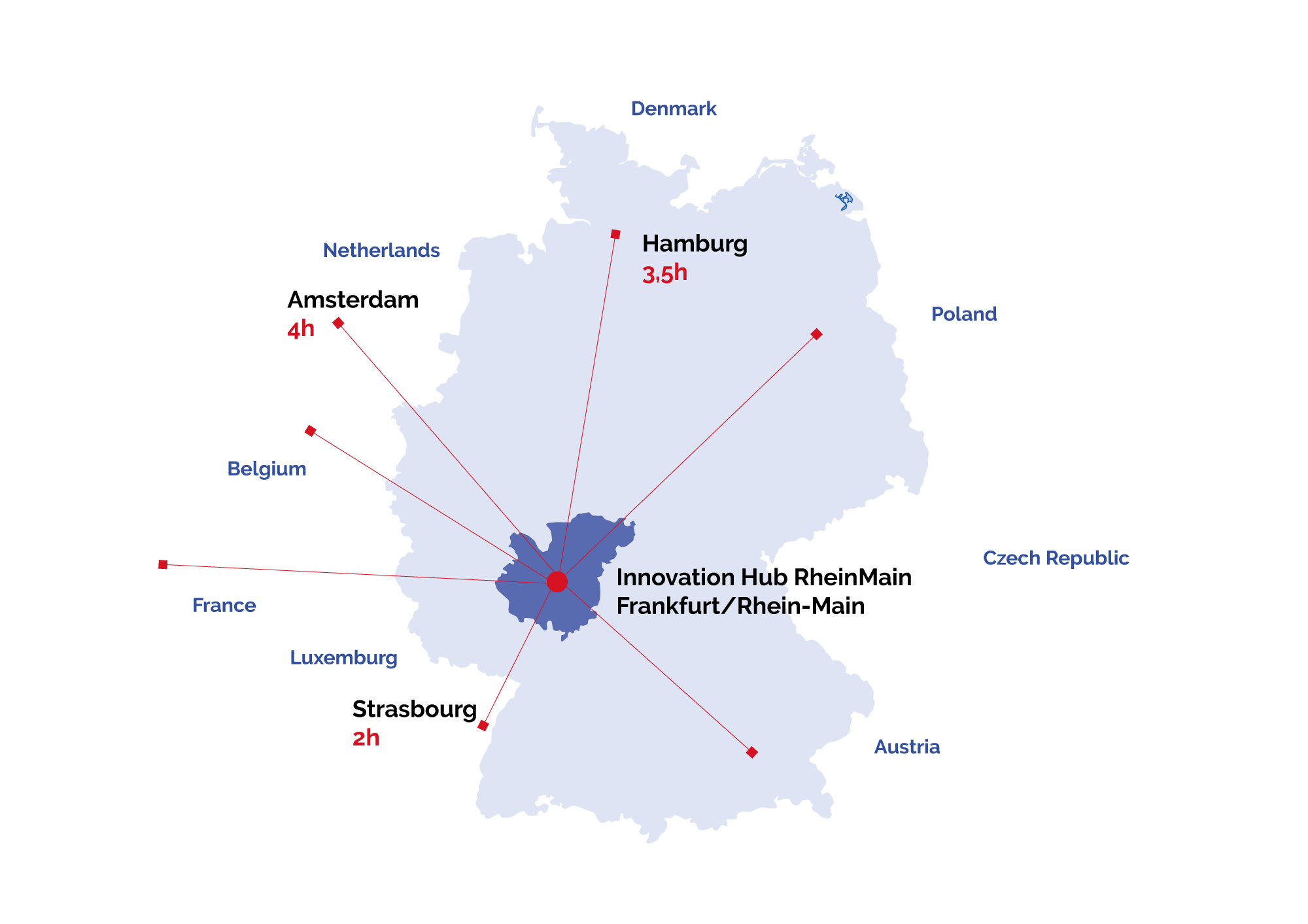
Frankfurt, in particular, is a central gateway. With one of Europe’s largest airports, direct flights to Asia, strong financial institutions and proximity to global industry clusters, it offers an ideal operational environment for European expansion.
Germany’s legal system is transparent. Regulations are clear. Corporate structures are stable. And once your company is registered in Germany, it gains credibility across the entire EU market.
Choosing the Right Legal Structure in Germany
The most common legal form for foreign subsidiaries is the German GmbH (limited liability company). This structure protects shareholders, limits liability and is widely accepted by banks, business partners and authorities.
In addition to the GmbH, there are several types of legal structures available for foreign companies in Germany, such as the AG (public limited company), KG (limited partnership), and sole proprietorship, each with its own requirements and advantages.
Establish a German GmbH company or dependance
To establish a GmbH when living in Germany, you must complete the following steps:
- Minimum share capital of €25,000
- A notarized Articles of Association
- Appointment of a Managing Director
- Registration in the German Commercial Register
- A German office address
It is essential to prepare and submit all required documents for each step to avoid delays in the process.
While this sounds straightforward, foreign companies often underestimate the administrative coordination required between notary, bank, tax office, commercial register and immigration office.
The Innovation Hub RheinMain acts as a local operational bridge. We support Asian companies by coordinating documentation, facilitating communication with professionals, and ensuring that your application documents are complete before submission to the relevant authority.
This significantly reduces delays during company formation in Germany.
The Commercial Register and Corporate Registration Process
After notarization, the managing director must open a German business bank account. The minimum share capital must be deposited, and the bank confirmation is submitted to the commercial register.
Only once the commercial register in Germany approves the entry does the company legally exist.
Delays often occur due to incomplete documents, missing bank statements, unclear ownership background or translation issues. Companies from South Korea, India or Pakistan sometimes face additional scrutiny due to compliance checks or cross-border verification requirements. Companies have to ensure all documents are complete and accurate to avoid such delays.
Through our structured soft-landing service, the Innovation Hub ensures that:
- Documents from the home country have to be properly legalized
- Bank statements meet German compliance requirements
- Communication with the German bank is efficient
- Notarial appointments are prepared in advance
This integrated service avoids costly repetition of submissions.
Germany Corporate Tax and Financial Planning
The effective Germany corporate tax rate is approximately 30%, including corporate tax, solidarity surcharge and trade tax. While Germany is not a low-tax country, it compensates with legal stability, infrastructure and access to Europe’s largest consumer market.
For CFOs planning long-term European expansion, predictability is often more valuable than tax minimization. For your financial planning, you will need to consider not only the tax rates but also compliance requirements and reporting standards specific to Germany.
The Innovation Hub RheinMain connects your company with experienced German tax advisors who specialize in Asian subsidiaries. This ensures that your accounting structure, VAT registration and cross-border transactions comply with German and European requirements from day one, and highlights the importance of preparing for your accounting and tax obligations for your business.

Labour Law and Employment Considerations in Germany
To operate a business or begin employment in Germany, it is essential to have a precise understanding of German labor law and employment regulations. Germany has one of the strongest employee protection systems in Europe. Employment contracts, working conditions, termination procedures, and all aspects of the employment relationship are clearly regulated by law.
In order to work in Germany, a valid residence permit is mandatory. If you enter Germany for employment purposes, you must apply in advance for a work visa or self-employment permit at the German embassy or consulate in your home country.
After arrival, you must obtain your final residence permit from the competent immigration office. During this process, various documents are required, including an employment contract, proof of health insurance, and proof of financial capacity. All application forms and supporting documents (such as proof of employment and proof of health insurance) must be prepared accurately and completely.
German labor law places a strong emphasis on employee welfare. The standard working time is generally limited to 40 hours per week, and overtime must be compensated separately. Employees are legally entitled to at least 20 days of paid annual leave. German work culture values family time, health, and a balanced work-life structure. In addition, every employee working in Germany must be enrolled in statutory health insurance, which is also a mandatory requirement for visa and residence permit applications.
If Korean and other Asian companies hire or assign employees to Germany, employment contracts must comply with local German labor law. Working conditions, salary structures, and social insurance contributions must fully align with German legal requirements. For foreign employees, visa and residence permit procedures can be complex. Therefore, it is important to carefully review all required documents and procedural steps in advance.
Employment in Germany involves more than simply signing a contract. It includes a range of legal obligations designed to protect employee rights and welfare. For this reason, Korean companies preparing to expand to Germany are strongly advised to consult with local labor law experts in order to assess and minimize potential employment-related risks.
Germany’s labor environment is stable and predictable, providing long-term trust and security for both employees and employers. To ensure successful business operations and smooth settlement in Germany, strict compliance with labor law and employment requirements is essential.
Residence Permit, Visa and Immigration Requirements for Managing Directors
Company formation in Germany is closely linked to immigration law when Korean or Indian executives relocate.
If a managing director moves to Germany, you may have to apply for a residence permit under the German Residence Act depending on your purposes of stay. The immigration office evaluates:
- Economic interest
- Financial stability
- Viability of the business
- Qualifications of the applicant
- Business plan and investment background
- Types of residence permits, including the settlement permit, and the requirement to meet certain conditions for the intended purposes of residence and work in Germany
Please note that important requirements or exceptions may apply for nationals of different countries when applying for a residence permit or visas.
The visa application process includes submission of passport copies, employment contracts (if applicable), bank statements, proof of health insurance, detailed business documentation, and payment of the visa fee. Visa applications are handled by the German mission in your home country, such as the German Embassy in South Korea or India. After arrival in Germany, the residence permit is finalized at the local immigration office. You have to provide proof of financial stability and work eligibility in Germany for the intended purposes.
Incomplete application forms or missing documents often delay approval. To be eligible for the specific type of residence permit, you have to meet all legal and financial requirements.
The Innovation Hub RheinMain supports:
- Preparation of application documents, ensuring that key topics relevant to your residence permit application are thoroughly covered
- Coordination with immigration professionals
- Scheduling appointments with the immigration authority
- Guidance regarding residence permit requirements
- Structuring documentation for self-employment or executive roles
- Providing guidance for your specific situation, offering tailored advice for your needs
Our goal is to make your arrival and settlement in Germany predictable and structured.
Living in Germany as a Korean Executive
Beyond company formation, living in Germany is an important consideration for executives and their families.
Germany offers:
- High-quality healthcare system
- International schools near Frankfurt
- Efficient public transport Germany-wide
- Safe residential areas
- Strong Korean and Indian expat communities
Frankfurt provides access to international restaurants, cultural activities and business networking events. The Korean expat community in Germany is particularly visible in the Rhine-Main region.
Family reunification is possible under the German Residence Act, provided that income requirements and housing conditions are fulfilled.
When working in Germany, it is essential to have the proper legal authorization, such as the appropriate visa or work permit, to comply with local regulations.
The Innovation Hub RheinMain supports not only business setup but also expat life integration:
- Assistance with school selection
- Introduction to local community networks
- Support during arrival and settlement
- Recommendations for professionals such as relocation consultants
- Access to business partners and networking events
We understand that expansion is not only a legal process — it is a human transition.

Why Frankfurt RheinMain Is Ideal for Asian Expansion
Frankfurt combines infrastructure, financial institutions and industrial connectivity.
The region offers:
- Direct flights to Asia
- Central location in Europe
- Access to skilled professionals
- Efficient administrative processes
- Strong logistics environment
Frankfurt is ideal in the context of Germany for Asian business expansion, serving as a gateway for companies looking to enter the European market due to its connectivity and business-friendly environment. For example, citizens of countries like New Zealand can travel to Germany for short-term business without a visa, making it easier for international partners to collaborate.
For companies from South Korea and India, Frankfurt is not just a destination — it is a strategic European headquarters location.

How the Innovation Hub RheinMain Simplifies Your Expansion to Germany
Opening a company in Germany requires coordination between multiple authorities: notary, commercial register, tax office, immigration office, bank and local administration.
The Innovation Hub RheinMain provides a structured soft-landing service tailored to Asian companies:
- Office address for registration
- Support with company formation Germany
- Coordination of documents and applications
- Assistance with business bank account setup
- Guidance through residence permit procedures
- Access to local tax advisors and legal experts
- Networking with business partners
- Proximity to Frankfurt Airport
At the Innovation Hub, you can find all necessary support for your business expansion, from legal and tax advice to networking opportunities and administrative assistance.
We focus specifically on companies from South Korea, India and other Asian markets expanding to Europe.
Our mission is to make your Germany business expansion simple, secure and professionally managed.
Start Your European Expansion with Confidence
Germany remains one of the strongest and most stable destinations in Europe for industrial and technology companies.
If you are planning to open a company in Germany from South Korea or India, structured preparation for the expansion process is the key to success. The right preparation for the required documents, applications, and local regulations is essential for the smoothest entry.
The Innovation Hub RheinMain acts as your operational bridge between Asia and Europe — supporting documents, applications, authorities and local integration.
Start your Germany business expansion with Innovation Hub RheinMain — and build your European presence with clarity, security and strategic direction.

FAQ – Opening a Company in Germany from South Korea or India
How long does it take to open a company in Germany?
The timeline for company formation Germany typically ranges between 4 and 8 weeks, depending on document preparation and bank account setup. For your company formation, you will need to prepare all required documents in advance, such as notarized Articles of Association and proof of minimum share capital, tailored to your specific situation.
To open a company in Germany, you must notarize the Articles of Association, deposit the minimum share capital, and register in the commercial register Germany. Delays often occur if documents from South Korea or India are incomplete or not properly legalized.
Professional coordination with local authorities, the bank, and the notary significantly accelerates your Germany business expansion.
What is the minimum share capital for a German GmbH?
To establish a German GmbH, the legal minimum share capital is €25,000. At least €12,500 must be deposited into a business bank account Germany before registration in the commercial register.
This structure limits liability and is the preferred choice for Korean and Indian companies planning long-term European expansion. Compared to a branch office, a GmbH builds stronger credibility with German banks, authorities and business partners.
What taxes does a company pay in Germany?
The effective Germany corporate tax rate is approximately 30%, including corporate tax, solidarity surcharge and trade tax.
While Germany is not a low-tax jurisdiction, it offers strong infrastructure, legal stability and access to the entire EU market. For many Asian companies expanding to Europe, predictability and market access outweigh purely tax-driven decisions.
Do Korean or Indian directors need a visa or residence permit?
Yes, if a Korean or Indian Managing Director relocates to Germany, a Germany business visa and later a permit of residence under the German Residence Act may be required. Nationals of non-EU countries must obtain a permit of residence to legally live and work in Germany.
The application is submitted at the German mission in your home country. After arrival, the local immigration office issues the permit of residence.
Authorities evaluate your business plan, financial background, qualifications, and the economic interest of your company in Germany. Incomplete visa applications, missing bank statements, or incorrect application forms often delay approval.
How can the Innovation Hub RheinMain support our expansion to Germany?
The Innovation Hub RheinMain provides a structured soft-landing service tailored to companies from South Korea, India and other Asian markets.
You can find all necessary support for your expansion through the Innovation Hub.
We support your Germany business expansion by offering:
- Office address for registration
- Assistance with company formation Germany
- Coordination of documents and authority communication
- Support opening a German business bank account
- Guidance through residence permit and visa applications
- Access to tax advisors and legal professionals
- Networking opportunities near Frankfurt
Our mission is to make your expansion in Germany efficient, secure and professionally managed — so you can focus on building your European headquarters and developing new business opportunities across Europe.
If you are planning to open a company in Germany from South Korea or India, the right preparation and local support are decisive.
Start your Germany business expansion with Innovation Hub RheinMain.
Disclaimer: This guide does not constitute legal advice and is intended for general informational purposes only. For specific legal questions or binding clarification, it is strongly recommended to consult a qualified lawyer or subject-matter expert.
The Innovation Hub will be happy to facilitate contact with experienced legal professionals or relevant experts upon request.